Abstract
The most useful definition of a quantum workflow includes the decisions around a circuit: objective, owner, baseline, source, route, execution state, result, and review. QFlow Studio gives those stages one durable operating record.
Gap map
A gated quantum workflow lifecycle
Every stage has an input, an accountable decision, and an artifact that should survive the next handoff.
Frame
- Question and owner
- Acceptance and stop criteria
- Classical reference
Build
- Circuit or hybrid model
- Visual structure
- Generated source
Preflight
- Simulator first
- Operation support
- Provider eligibility
- Resource fit
Run
- Explicit submit
- Queue and state
- Failure and retry
- Raw output
Prove
- Trace and exports
- Review note
- Share boundary
- Reuse or stop
A circuit is an artifact inside a quantum workflow, not the workflow itself.
A circuit describes operations on qubits. A quantum workflow also explains why the circuit exists, which classical reference applies, how the implementation was inspected, where it was routed, what execution state occurred, and how the result will be judged. Without those surrounding decisions, teams accumulate demos that are difficult to compare, repeat, or hand over.
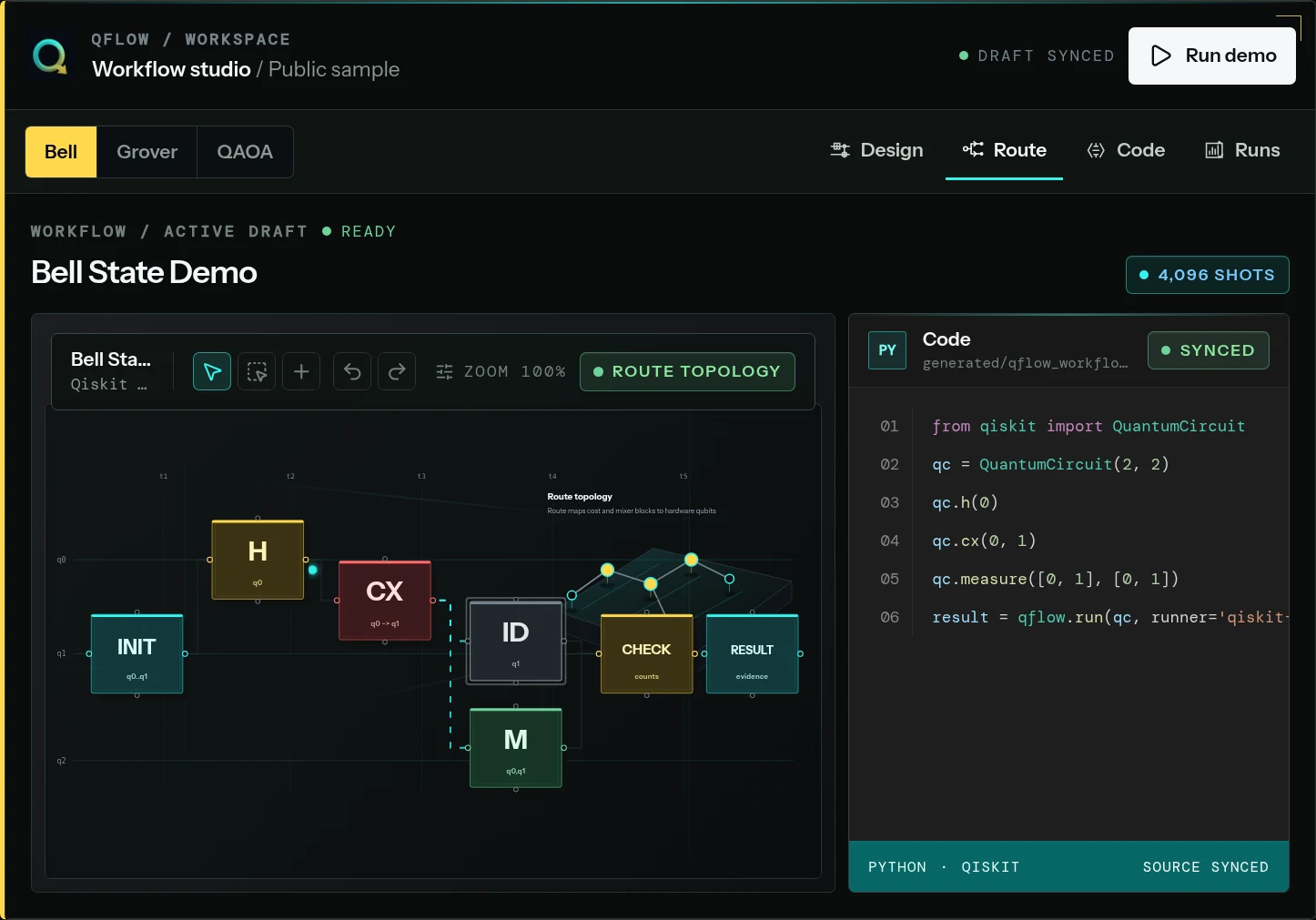
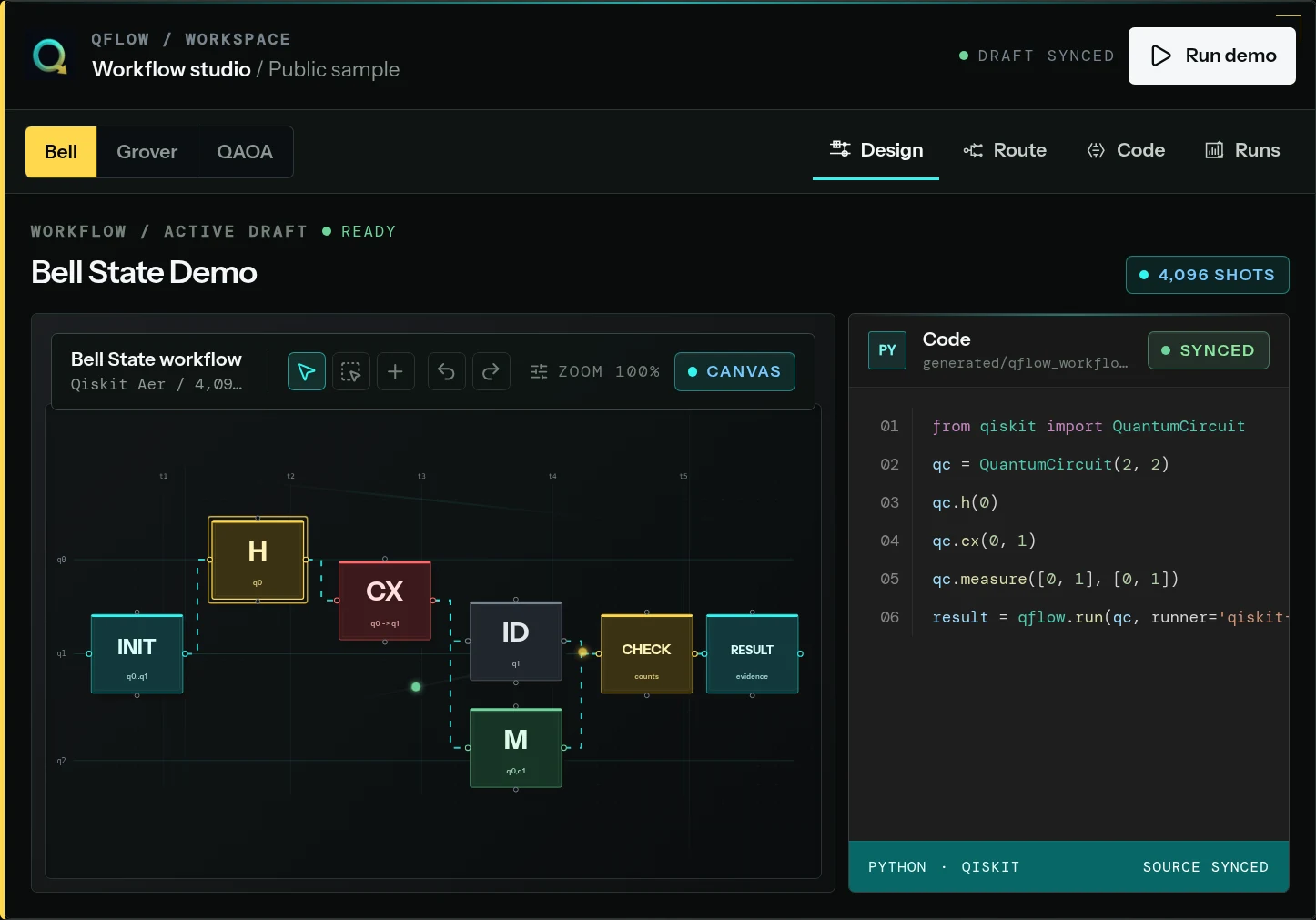
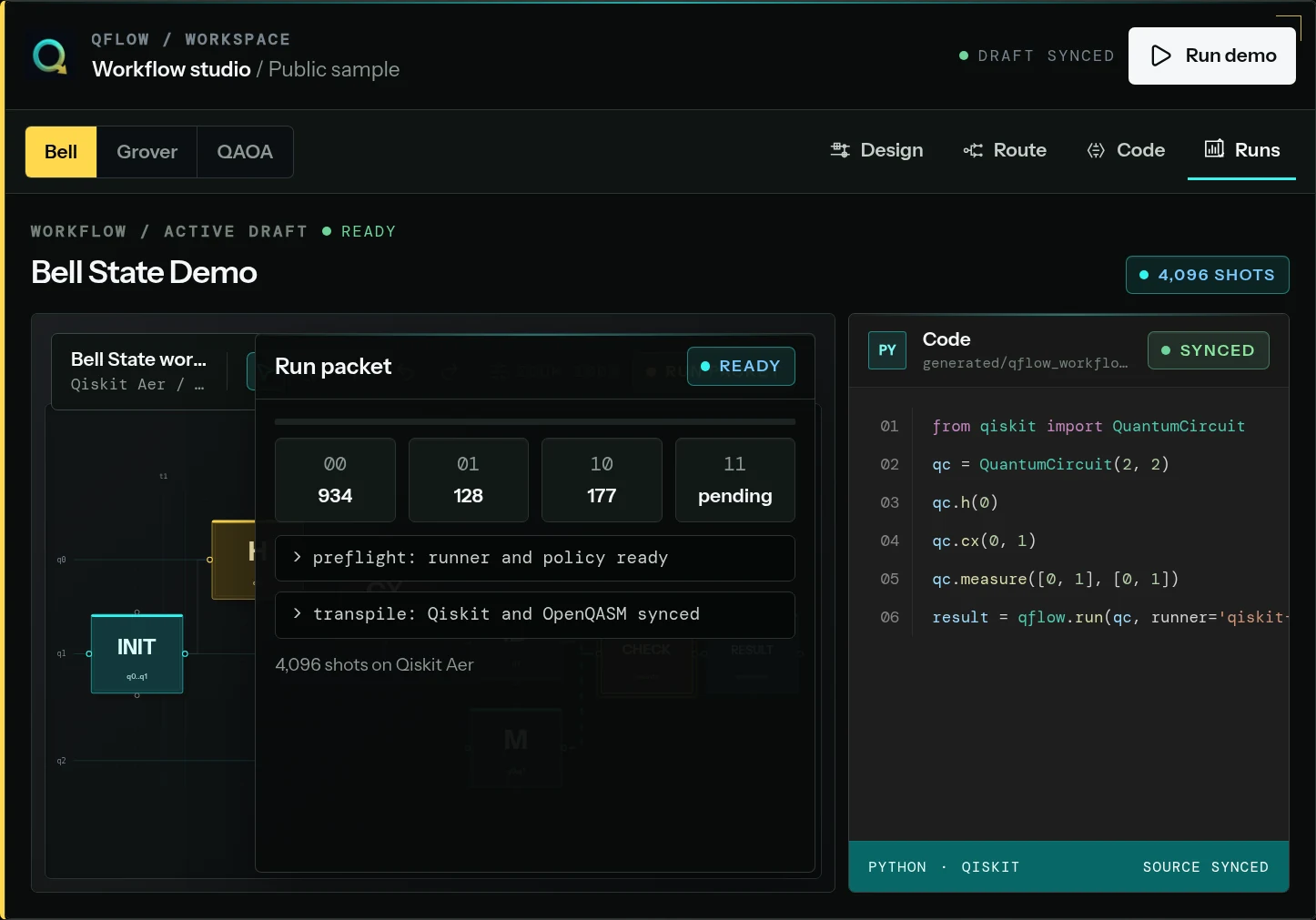
QFlow Studio organizes that larger unit as a workflow record. The record keeps the brief, visual design, generated source, route context, run history, result, and evidence together. This complements provider-specific development patterns while giving learners, researchers, engineers, and reviewers one shared operational vocabulary.
TD · Technical depth6 supporting chapters and the working checklist.Read deeper
Define the question, owner, baseline, and stop condition before choosing gates.
The brief names the question, intended user, inputs, constraints, expected behavior, classical comparator, and the decision the experiment may inform. A teaching lab may ask whether a learner can explain Bell correlations. A research workflow may compare a noisy distribution with an ideal model. A pilot may ask whether a bounded formulation deserves another experiment.
The stop condition is equally important. The workflow may stop if a classical method already meets the need, the circuit exceeds the available route, a required operation is unsupported, or the result cannot change the next decision. This prevents hardware access or algorithm novelty from becoming the objective by default.
- Write one falsifiable, teachable, or decision-relevant question.
- Name the expected distribution or classical comparator.
- Record who owns the workflow and who approves an external submission.
- State what would stop, narrow, or redirect the work.
Use the canvas and generated source as two inspection surfaces for the same intent.
A visual canvas exposes qubit lines, gate order, controls, measurements, and larger workflow blocks. Generated Qiskit, Cirq, or OpenQASM exposes a more exact implementation view. The representations are useful together when a reviewer can trace a meaningful canvas edit to its source-level consequence.
Inspection covers register sizes, control and target direction, parameters, measurement mapping, depth, unsupported operations, and hybrid boundaries. The record must identify the source snapshot that belongs to the run; the latest editor state cannot silently stand in for an earlier execution.
Choose a route by workload fit and evidence need, not by logo.
Preflight asks whether the workflow should use a local ideal simulator, a noisy simulator, a resource-estimation path, or an eligible provider target. The decision should account for operation support, qubit needs, compiled structure, credentials, quotas, queue context, expected cost, and what hardware would teach that simulation cannot.
QFlow’s public integration matrix separates submit-capable beta adapters from validation, access-preflight, credential-test, and planned specialized paths. Unsupported routes should fail visibly at preflight. Provider accounts, regions, permissions, charges, and terms remain controlled by each independent provider.
Execution state belongs beside the exact workflow that caused it.
A run identifies the workflow version, source snapshot, selected route, runner, shot configuration, approval, and submission time. Simulator and hardware runs need different interpretation: simulation supports fast structural checks, while hardware adds queue, device, compilation, calibration, noise, and provider-availability context.
Queued, running, completed, failed, cancelled, and retried states can all matter. Recording the reason for a retry prevents a polished final histogram from hiding a changed source, route, shot plan, or operational failure. Negative and failed runs are evidence when they affect the next choice.
- Make external submission explicit and human-visible.
- Do not silently substitute a simulator result for a failed hardware route.
- Retain failure and retry reasons when they affect interpretation.
- Attach raw output before preparing a presentation summary.
Compare the result with the acceptance rule that existed before the run.
The interpretation stage compares raw output with the expected distribution, analytic reference, classical baseline, or pilot acceptance rule. Any normalization, mitigation, aggregation, state filtering, or other post-processing should be visible and versioned. A result should not acquire a stronger claim because it looks persuasive in a chart.
The correct conclusion may be that the implementation is sound on a simulator, that a provider path introduced behavior requiring study, or that the classical baseline remains better. A workflow earns credibility by making these boundaries legible, not by forcing every result into a success story.
Close the lifecycle with evidence that can inform the next workflow.
A reviewer should be able to determine what was built, which source represented it, how and where it ran, and what returned. QFlow’s evidence surface connects those answers to outputs, exports, a run trace, review notes, and a share boundary that excludes credentials and private workspace data.
The completed record can become a reusable blueprint, classroom lab, research comparison, provider evaluation, or input to an investment gate. Reuse should preserve version and context rather than copying only the circuit. The next team needs to know which assumptions remain valid and which must be checked again.
question → model → source → preflight → run → interpretation → evidence → next decisionPractical takeaways
01
Define a quantum workflow as the full decision and evidence path around a circuit.
02
Frame the objective, baseline, owner, and stop condition before selecting a provider.
03
Review the visual design and generated source as two views of one implementation.
04
Separate simulator, beta-submit, validation, preflight, credential-test, and planned routes.
05
Preserve positive, negative, failed, and retried results so the record can guide later work.
RA · Reference annexDefinitions, recurring questions, editorial method, and primary sources.Inspect
The analysis above carries the main reading flow. This reference layer keeps terminology, recurring questions, editorial method, and primary sources available without interrupting the argument.
Field questions
Program questions behind What is a quantum workflow? From a research brief to reusable evidence..
Q01What is a quantum workflow?
A quantum workflow is the connected path from a question and baseline through circuit or hybrid-model design, source inspection, route preflight, execution, result interpretation, and reusable evidence. The circuit is one artifact inside that larger process.
Q02Why should a quantum workflow start on a simulator?
Simulator-first work exposes structural, source, mapping, and expected-result errors quickly without consuming external hardware access. Hardware becomes useful when the workflow names a device-specific question that simulation cannot answer.
Q03Does a completed quantum job mean the workflow succeeded?
No. Completion only means execution reached a terminal result. Success depends on the acceptance rule, baseline, route context, output quality, limitations, and the decision the result can responsibly support.
Q04What should survive after a quantum workflow ends?
Keep the brief, owner, circuit, executed source snapshot, route and status, non-secret configuration, raw output, transformations, failures or retries, reviewer note, and share boundary.
Editorial record
How What is a quantum workflow? From a research brief to reusable evidence. was checked.
- Editorial owner
- Neura Parse Research
- Last verified
- July 20, 2026
- Method
- Synthesis of the dated primary and official records listed below, checked against the operating question in this note.
- Scope limit
- Planning analysis—not certification, customer performance evidence, procurement advice, or a claim of production readiness.
SRSources reviewed
6 records