
Abstract
A QPU is not the automatic final step of every quantum experiment. Each route should answer a question the previous route cannot: first validate the model, then the ideal implementation, then stated noise assumptions, and only then authorize hardware when device behavior matters to the decision.
Gap map
Progress only when the next route answers a new question.
Each gate has an acceptance rule, a stop condition, and an artifact that remains attached to the final interpretation.
Reference
- Analytic expectation
- Classical baseline
- Acceptance and stop rule
Ideal local
- Circuit semantics
- Measurement mapping
- Deterministic or sampled reference
Noisy local
- Named noise model
- Target snapshot
- Sensitivity comparison
Authorized QPU
- Current access and status
- ISA and resource fit
- Budget approval
- Run evidence
Hardware is a question-specific route, not a graduation ceremony for a circuit.
The useful comparison is not whether a simulator or QPU is universally better. It is which route can answer the current question with the least unsupported assumption and the clearest evidence. An analytic calculation may expose a flawed objective. Ideal simulation may expose circuit or measurement errors. Noisy simulation can test an explicit model. Hardware can reveal behavior under a real device, queue, compiler, calibration, and control stack.
A gated workflow prevents teams from spending scarce access merely to reproduce an error that a cheaper route could have caught. It also prevents a simulator result from being presented as evidence of hardware behavior. Every transition should name the unresolved question, acceptance threshold, budget, owner, and stop condition before execution begins.
TD · Technical depth6 supporting chapters and the working checklist.Read deeper
Establish an analytic or classical reference before simulating the circuit.
For a small circuit, write the expected state, observable, or output distribution. For a larger problem, identify the strongest tractable classical baseline and the quantity that will be compared. This reference catches mismatched objectives and supplies a stable acceptance rule for later routes.
The reference should also define a stop condition. If the classical method already satisfies the operational need, if the mapped circuit is outside the available resource envelope, or if the proposed measurement cannot distinguish the competing hypotheses, the responsible outcome is to stop or reformulate before selecting a provider.
- Name the decision-relevant output before choosing a backend.
- Record the expected ideal value or distribution and its tolerance.
- State which result would stop, narrow, or redirect the workflow.
Use ideal simulation to validate semantics, not to predict device behavior.
Qiskit SDK reference primitives support local ideal simulation for fast prototyping. This route is useful for verifying gate order, parameters, observable definitions, measurement mapping, and post-processing against the reference. It provides a controlled baseline before device assumptions enter the experiment.
Ideal statevector methods scale poorly with qubit count and do not model hardware noise. A successful ideal run means that the tested implementation behaves under the simulator’s mathematical assumptions; it does not mean the circuit will fit a target, survive transpilation, or produce the same distribution on a QPU.
Use noisy simulation to test a declared model, not to impersonate hardware.
Qiskit Aer can execute exact or noisy simulations, while Runtime local testing can use Aer or fake backends built from QPU snapshots. A target snapshot contributes basis gates, connectivity, and sampled device properties that are useful for testing transpilation and approximate device-aware behavior before submission.
The output remains a model result. A snapshot ages, a simplified noise model omits behavior, and most Runtime options other than shots are ignored in local testing mode. IBM also states that the beta Executor primitive does not support local testing mode. Preserve the noise model, snapshot or target, simulator method, seed, shots, and ignored-option boundary so the result cannot be mistaken for a live provider run.
- Compare ideal and noisy outputs using the same acceptance quantity.
- Identify which noise sources the model includes and omits.
- Do not call a fake-backend result a hardware result.
- Recheck circuit size and memory limits before committing local resources.
Route to hardware only after access, target fit, budget, and purpose pass preflight.
A QPU route is justified when the question concerns real-device behavior or when a hardware run supplies evidence unavailable from the accepted simulation model. Preflight should verify current account and region access, operational status, supported instructions, qubit and connectivity fit, target-aware transpilation, primitive and execution mode, expected usage, queue context, data policy, and an explicit submitter approval.
Once hardware is justified, choosing among eligible backends becomes a separate decision across topology, transpilation, calibration, queue, and access context. Use the dedicated backend-selection guide for that comparison rather than treating least-busy status or qubit count as a complete score.
QPU go = unresolved hardware question + eligible account + ISA fit + approved budget + reviewable run planA blocked hardware route should not silently become a different experiment.
If credentials fail, access is unavailable, the target is non-operational, compilation exceeds the route, or the budget is not approved, the workflow should enter a visible hold or stop state. A local simulation may still be useful, but it must be stored as a separate route with a separate result label—not substituted under the original hardware claim.
Retry criteria should also be explicit. Device drift and calibration changes mean a later run may occur under different conditions. Preserve the reason for retry, the new backend or calibration context, any source or option change, and whether the acceptance rule remained fixed. Otherwise the final result becomes survivor selection rather than a traceable experiment.
One workflow can compare routes while keeping their claims separate.
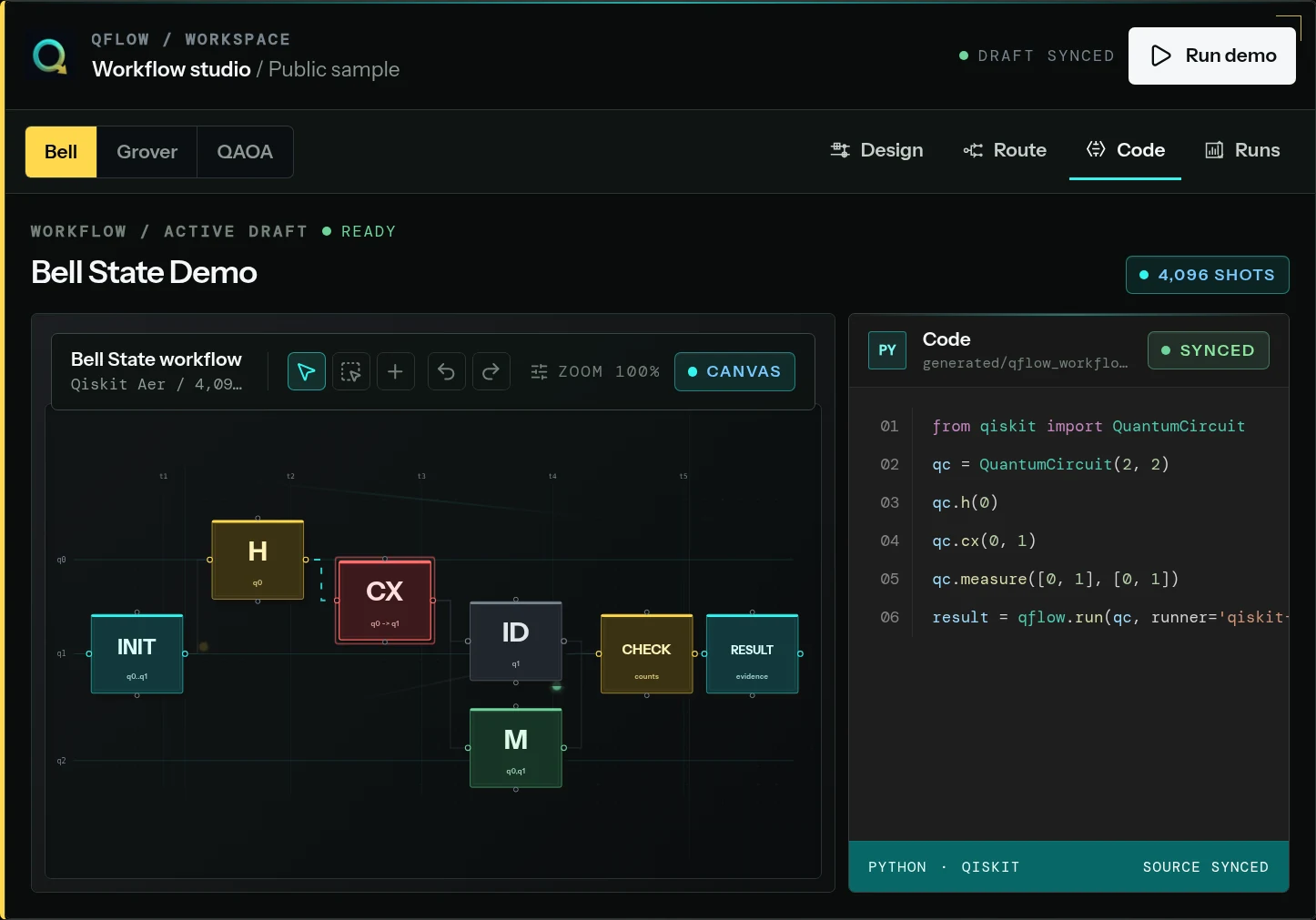
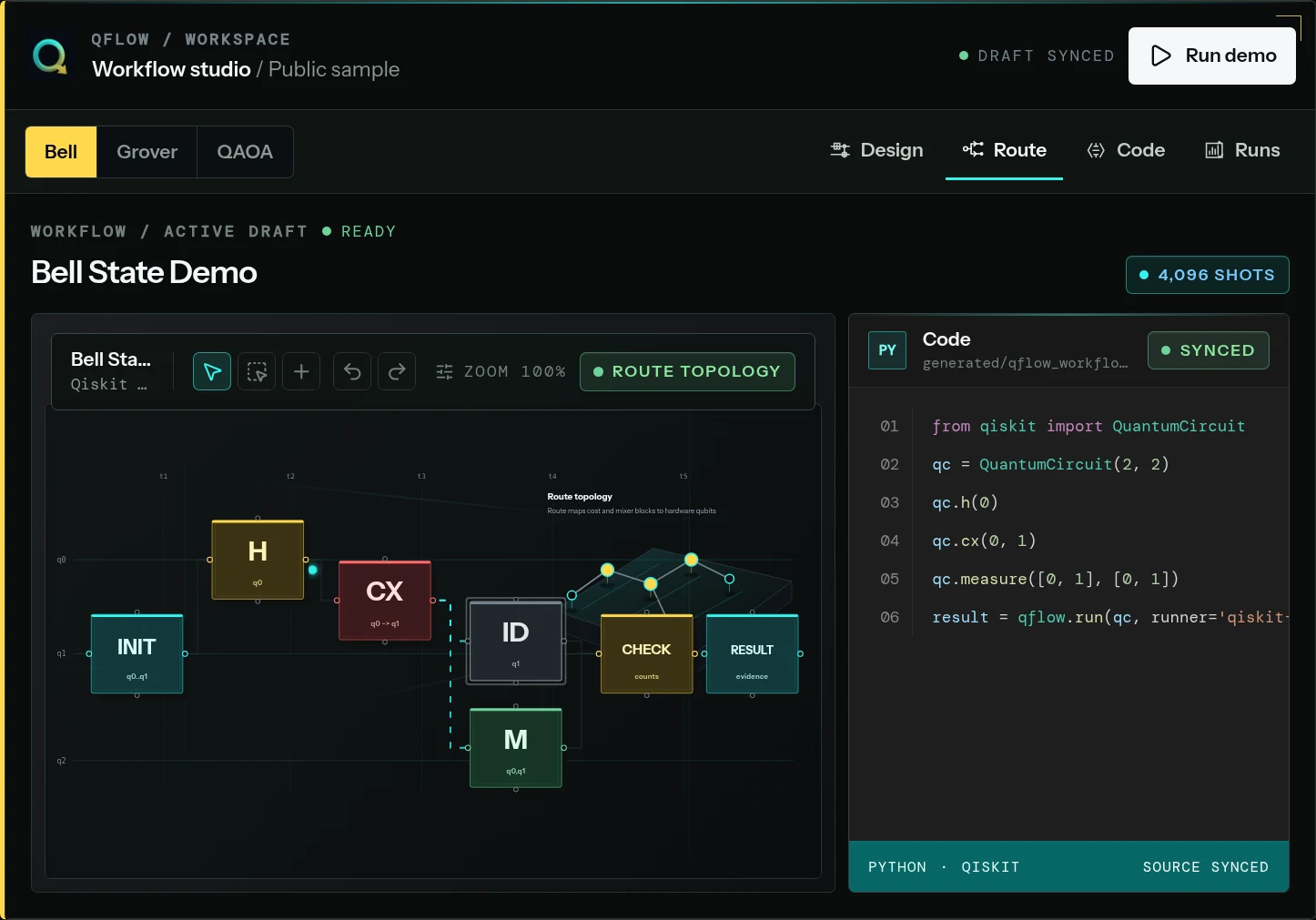
QFlow Studio’s workflow and evidence model can connect a brief, visual circuit, generated source, route decision, run trace, result, export, and reviewer note. This makes it possible to compare analytic, simulator, and authorized provider evidence without flattening them into one ambiguous histogram.
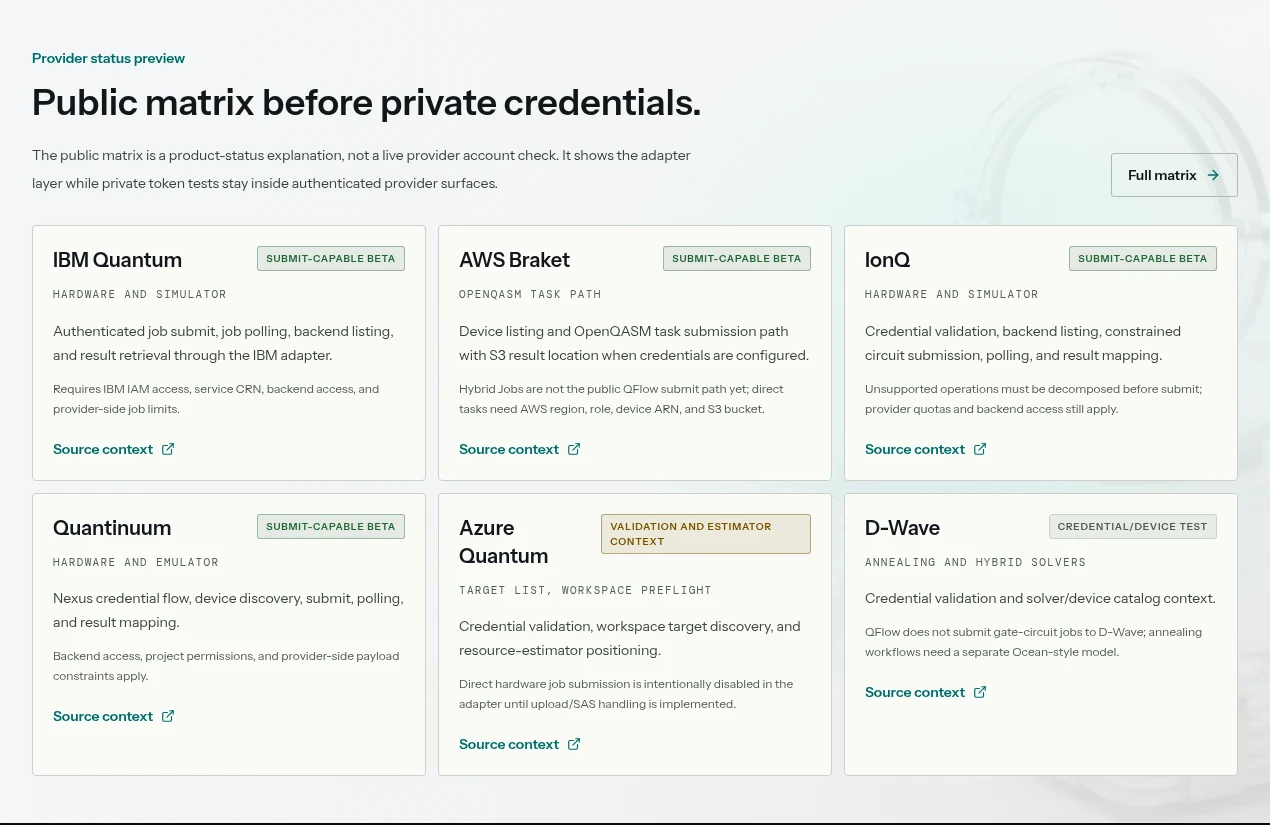
Live capability must still follow QFlow’s dated integration matrix. A provider card can represent validation, preflight, credential testing, beta submit, or planned work; these states are not interchangeable. Provider credentials, quotas, pricing, hardware access, scheduling, and result authority remain with the independent provider and the user’s account.
Practical takeaways
01
Start with an analytic or classical reference and a stop condition.
02
Use ideal simulation to validate implementation semantics, not to predict a physical device.
03
Treat noisy and fake-backend simulation as explicit models with dated assumptions.
04
Authorize a QPU only when access, ISA fit, budget, and a hardware-specific question all pass preflight.
05
Keep simulator and hardware routes separately labelled in the evidence record; never substitute one silently for the other.
RA · Reference annexDefinitions, recurring questions, editorial method, and primary sources.Inspect
The analysis above carries the main reading flow. This reference layer keeps terminology, recurring questions, editorial method, and primary sources available without interrupting the argument.
Field questions
Program questions behind Quantum simulator vs QPU: earn every move toward hardware..
Q01Should every quantum workflow eventually run on a QPU?
No. A QPU is justified when it answers a hardware-specific question that the accepted analytic or simulation route cannot. A workflow can responsibly stop after simulation if hardware evidence would not change the decision.
Q02What is the difference between ideal and noisy quantum simulation?
Ideal simulation follows the mathematical circuit without a device-noise model. Noisy simulation applies a declared model or target snapshot. Neither is identical to a live QPU, and both should retain their assumptions with the result.
Q03Does a Qiskit fake backend execute on quantum hardware?
No. A fake backend uses a QPU snapshot to mimic properties such as basis gates, topology, and approximate noise for local testing. Its output remains simulated.
Q04Does a QFlow provider card prove that QPU submission is supported?
No. QFlow’s status matrix distinguishes validation, preflight, credential-test, beta-submit, local, and planned routes. The current status and the user’s independent provider eligibility must both be verified.
Editorial record
How Quantum simulator vs QPU: earn every move toward hardware. was checked.
- Editorial owner
- Neura Parse Research
- Last verified
- July 20, 2026
- Method
- Synthesis of the dated primary and official records listed below, checked against the operating question in this note.
- Scope limit
- Planning analysis—not certification, customer performance evidence, procurement advice, or a claim of production readiness.
SRSources reviewed
8 records