
Abstract
A minimum quantum execution record connects workflow identity, source, route, run, output, transformation, and approved review material. It improves reconstruction without pretending that a manifest alone guarantees scientific reproduction.
Gap map
An evidence packet is a reconstruction map.
The manifest connects public proof while marking private fields and research context that may require separate preservation.
Identity
- Workflow and run IDs
- Owner
- Version
- Created time
Implementation
- Canvas version
- Source snapshot
- Qiskit path
- OpenQASM path
Execution
- Route and status
- Runner
- Shots and seed
- Trace and retry
Result
- Raw counts
- Exports
- Transformations
- Reference comparison
Boundary
- Reviewer note
- Approval
- Private fields excluded
- Known gaps
Counts can be authentic and still be too weak to reconstruct the experiment.
A chart may accurately represent one output file while leaving essential questions unanswered. Which circuit version ran? Was the source generated before or after the final canvas edit? Did the output come from an ideal simulator, noisy model, or provider target? How many shots were requested, and did a retry change the route?
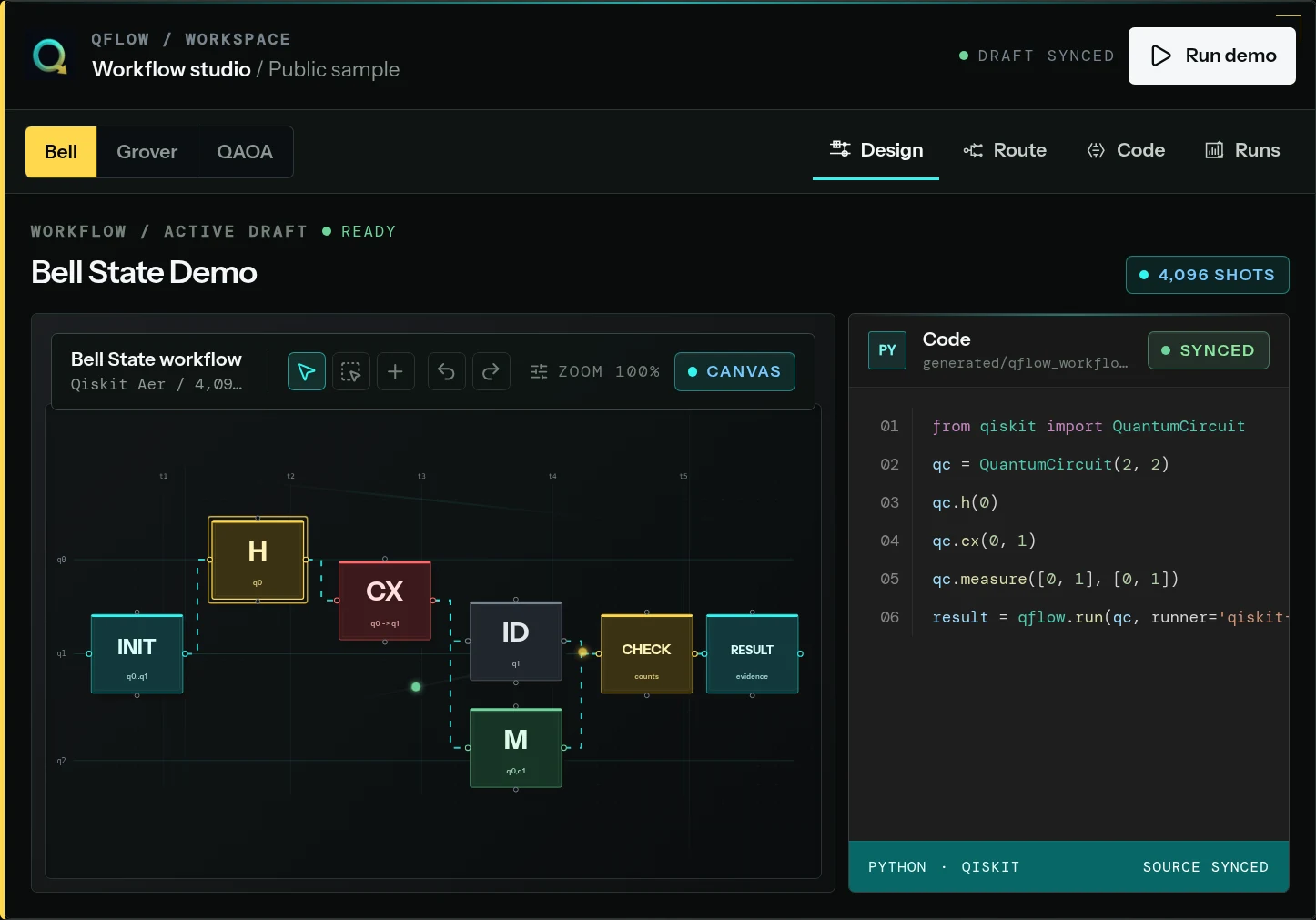
Reproducibility begins by preserving the dependency chain around the counts. QFlow addresses this as a workflow-record and evidence-packet problem: the result stays attached to identity, source snapshot, route, runner, run trace, exports, review notes, and an explicit statement of fields excluded from sharing.
TD · Technical depth6 supporting chapters and the working checklist.Read deeper
Freeze the implementation tied to the run, not merely the latest editor state.
A minimum record needs stable workflow and run identifiers plus a source snapshot tied to that execution. The canvas may continue evolving after a run, so a reviewer cannot assume that today’s visual state produced yesterday’s result. Version, owner, and timestamp make that distinction visible.
QFlow’s documented manifest includes a source snapshot with generated Qiskit and OpenQASM paths. Where source was exported or changed outside the studio, the record should state the boundary instead of presenting generated and executed code as automatically identical.
- Identify the workflow, run, owner, and accepted version.
- Attach the exact source snapshot associated with execution.
- Record external edits or repository commits when code leaves the studio.
- Keep the current editor state separate from historical run state.
Package, compiler, and stochastic settings belong in research-grade records.
The public evidence manifest is a practical minimum, not the ceiling for research. A reproducible study may also need SDK, package, transpiler, compiler, simulator, and operating-environment versions; random seeds; optimization levels; noise-model configuration; and resource-estimation assumptions.
These details can live as supplemental artifacts when the base manifest does not expose a dedicated field. The important property is discoverability: another person should see that context exists, where it is stored, and which version belongs to the run rather than hunting across messages and notebooks.
Route, runner, shots, trace, and retries are part of the result.
The same logical circuit can produce different operational records on an ideal simulator, noisy simulator, resource estimator, and hardware route. The record should therefore preserve route type and status, runner, shots, seed where relevant, provider job reference, timestamps, queue and execution states, failure reason, and retry history.
Hardware comparisons may also require the available backend, topology, calibration, compilation, and mitigation context. When a provider does not expose a required field or historical snapshot, say that it is unavailable. Missing information is safer than silently pretending it did not matter.
Preserve measured output before compressing it into a conclusion.
Raw counts, probabilities, JSON or CSV rows, and a run trace allow a reviewer to verify the transformation behind a chart. A derived metric should identify its calculation and reference. If post-processing removes states, normalizes a subset, mitigates error, aggregates jobs, or chooses the best of several attempts, that transformation should be visible.
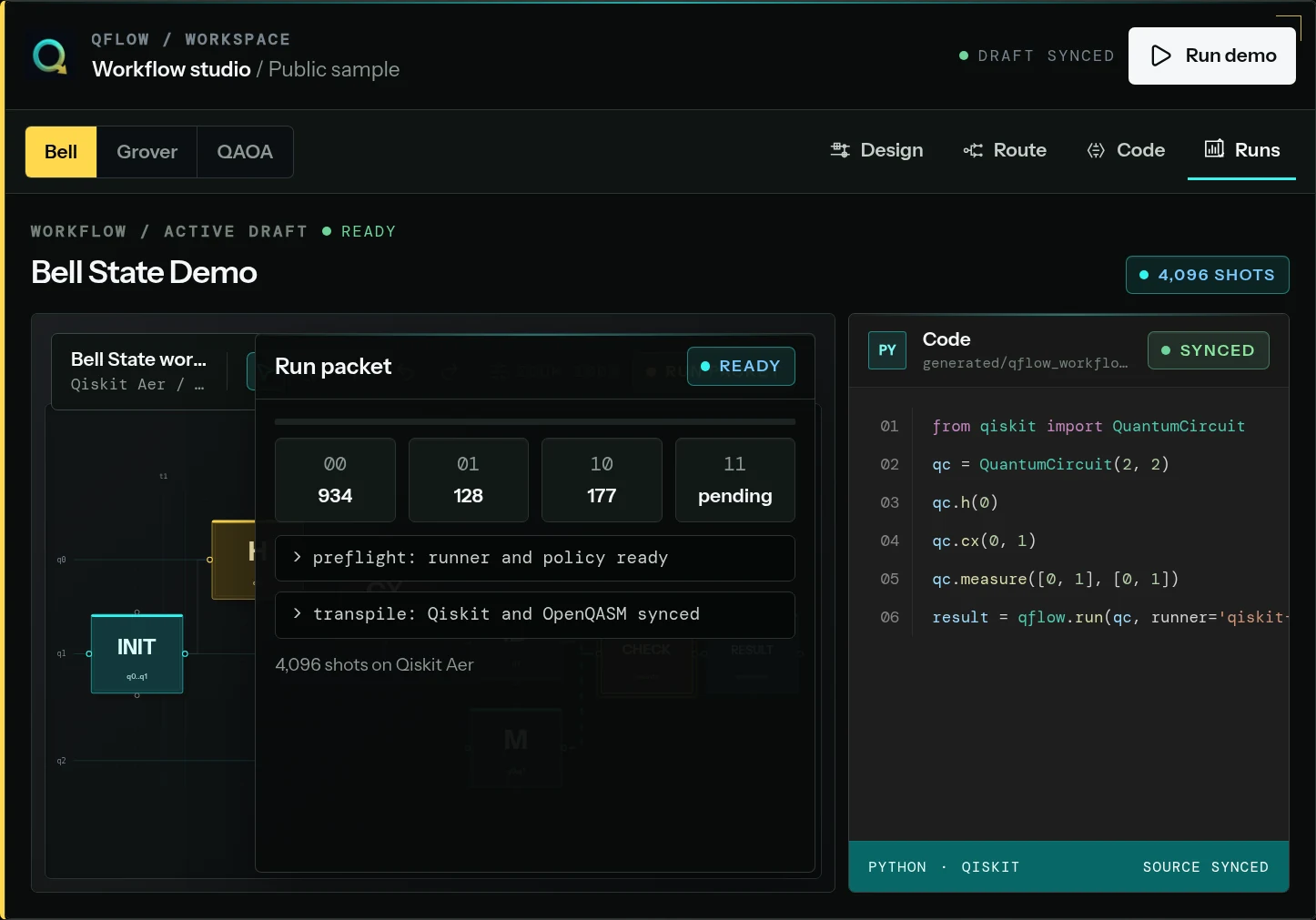
QFlow’s public Bell evidence example demonstrates a narrow artifact chain: source, counts and exports, trace, a share-safe link, and a manifest stay connected. It is evidence of the packet design, not proof that every future experiment becomes reproducible because an export button exists.
raw output + declared transformation + reference + reviewer note = interpretable derived resultConnect entities, activities, and reviewers instead of flattening everything into one file.
W3C PROV distinguishes entities such as a source snapshot or result file, activities such as compilation and execution, and agents such as a workflow owner or reviewer. Workflow Run RO-Crate applies a related idea to packaging computational runs. These models are useful because provenance is relational: a file matters through how it was produced and used.
QFlow’s workflow record can act as the user-facing index into that graph. It does not have to replace repositories or research packages. It should point clearly from the brief to source, route, run, exports, transformation, review, and next decision so additional artifacts remain understandable.
Test reconstruction without exposing credentials or private administration data.
Provider tokens, billing state, administrator permissions, private emails, and raw secrets do not help reproduce the scientific path. They create security risk. A reviewer-safe packet should expose sufficient circuit, source, route, run, and output context while explicitly marking private fields as excluded.
The final test is practical: ask a reviewer unfamiliar with the run to identify the exact source, route, runner, shots, raw output, transformations, and known gaps, then attempt a controlled rerun. Stochastic results need a declared tolerance or distributional comparison; reproducibility does not require every finite-shot sample to be numerically identical.
- Can the reviewer locate the executed source snapshot?
- Can they distinguish simulation, hardware, validation, and preflight context?
- Are raw output and every material transformation available?
- Are version, seed, noise, compilation, and calibration fields attached when relevant?
- Does the packet state what is private, unavailable, or outside scope?
Practical takeaways
01
Treat a histogram as an output artifact, not a complete experiment record.
02
Tie every run to stable identity, source, route, runner, configuration, raw output, and trace.
03
Use the documented manifest as a minimum and attach domain-specific environment and calibration context.
04
Preserve failed and negative attempts when they affect interpretation or cost.
05
Exclude secrets while keeping the procedure, evidence chain, limitations, and review decision reconstructable.
RA · Reference annexDefinitions, recurring questions, editorial method, and primary sources.Inspect
The analysis above carries the main reading flow. This reference layer keeps terminology, recurring questions, editorial method, and primary sources available without interrupting the argument.
Field questions
Program questions behind Reproducible quantum experiments need more than a histogram..
Q01What makes a quantum experiment reproducible?
Another person must be able to reconstruct the question, exact implementation, environment, route, non-secret execution settings, raw output, transformations, limitations, and interpretation. Identical finite-shot counts are not required; a declared comparison rule is.
Q02Is a QFlow evidence packet a scientific reproducibility guarantee?
No. It provides a connected minimum record and privacy boundary. Research-grade reproduction may need additional package versions, seeds, noise models, calibration snapshots, compiler settings, classical code, and data that the team must attach.
Q03Should failed quantum runs remain in the record?
Yes when they affect interpretation, configuration, cost, or the next decision. Keep failure and retry reasons so a final successful run does not erase material workflow history.
Q04Do provider credentials belong in reproducibility evidence?
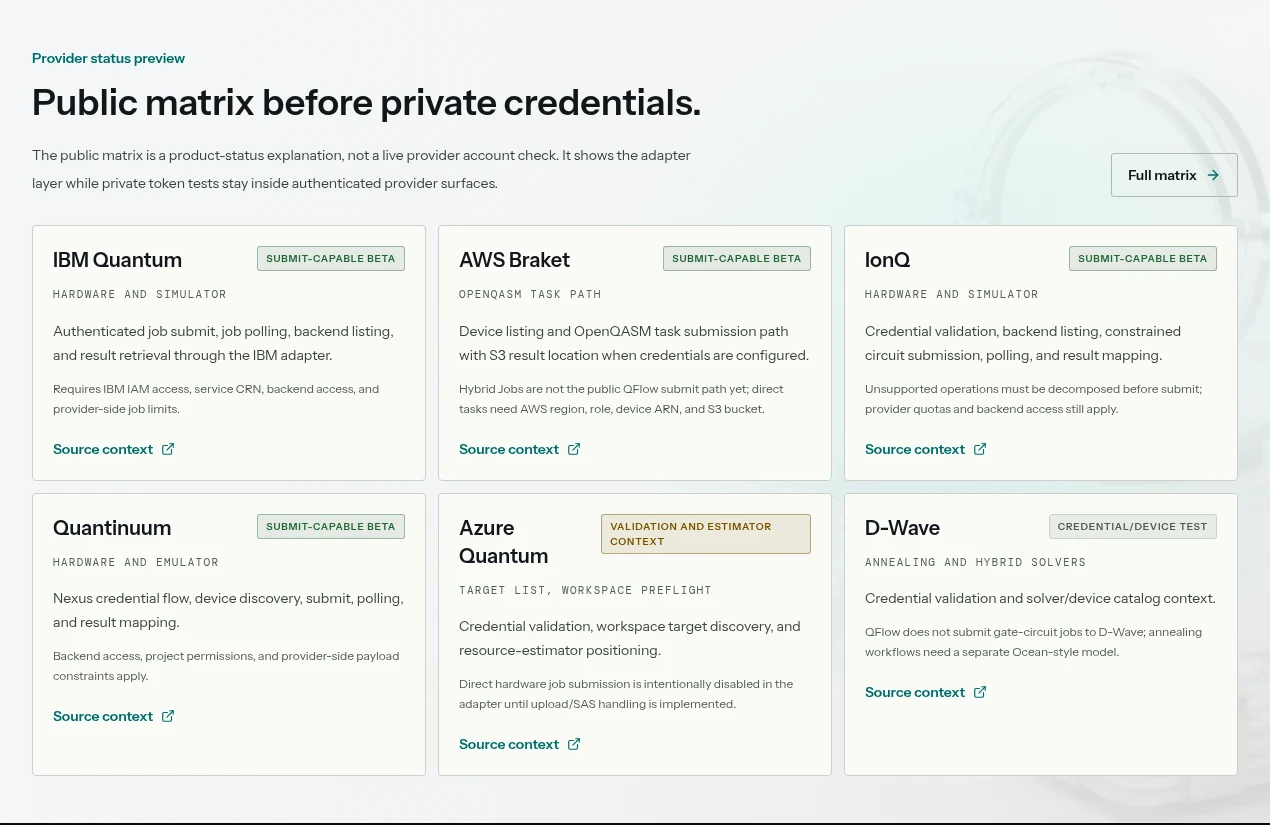
No. Record the non-secret provider route, target context, and job reference needed for review, but exclude tokens, raw credentials, billing state, private user data, and administrative notes.
Editorial record
How Reproducible quantum experiments need more than a histogram. was checked.
- Editorial owner
- Neura Parse Research
- Last verified
- July 20, 2026
- Method
- Synthesis of the dated primary and official records listed below, checked against the operating question in this note.
- Scope limit
- Planning analysis—not certification, customer performance evidence, procurement advice, or a claim of production readiness.
SRSources reviewed
7 records