
Abstract
A primitive should be selected from the scientific quantity the workflow needs. Sampler returns measured output-register samples, Estimator estimates observable expectation values, and beta Executor follows lower-level execution directives without silently choosing a mitigation strategy.
Gap map
Choose the primitive from the question and required output.
The same circuit can support different experiments; the expected decision determines the interface and the evidence to retain.
Question
- Which bitstrings occurred?
- What is an observable expectation?
- Which exact execution directives must run?
Interface
- SamplerV2
- EstimatorV2
- Executor beta
Result
- Register samples
- Expectation values and uncertainty
- Directive-controlled samples and metadata
Review
- PUB and ISA snapshot
- Shots or precision
- Runtime options
- Transformation and mitigation record
Primitive selection begins with the quantity the experiment must return.
Qiskit Runtime primitives provide task-oriented interfaces to IBM Quantum hardware. SamplerV2 samples output registers. EstimatorV2 estimates expectation values of observables. The newer Executor interface, currently beta, accepts a directed quantum program and exposes lower-level control over how circuit variants are generated and executed.
These interfaces are not three quality levels. Estimator is not automatically more scientific than Sampler, and Executor is not automatically better because it offers more control. The correct interface is the one whose inputs and outputs match the predeclared question and whose assumptions the team can review.
TD · Technical depth6 supporting chapters and the working checklist.Read deeper
Choose Sampler when measured output-register samples are the evidence.
Sampler executes one or more circuits and returns shot-based measurement data for their output registers. It is a natural fit for Bell correlations, Grover-style outcome distributions, bitstring constraints, and other experiments where the measured samples themselves support the analysis.
A Sampler PUB contains a circuit, optional parameter values, and optional shots. Review must cover classical-register mapping, shot count, parameter broadcasting, circuit metadata, and any post-processing that turns samples into probabilities or summary statistics. Sampler is not a general request for the full quantum state, and a histogram alone is not a complete experiment record.
- Verify that the circuit contains the measurements the question requires.
- Preserve raw register data before normalization or aggregation.
- Record shot allocation and parameter bindings with each PUB result.
Choose Estimator when the target is an observable expectation value.
Estimator combines a circuit, one or more observables, optional parameter values, and an optional target precision. It returns expectation-value estimates and associated uncertainty information. This model fits cost functions, energy estimates, and parameter sweeps where an observable—not a displayed bitstring distribution—is the scientific quantity of interest.
Observable layout matters. After transpilation, observables must correspond to the circuit’s physical layout. Commuting observables should be grouped deliberately when the workflow intends to estimate them from the same measurement basis. IBM also notes that measurement instructions in an Estimator input circuit are ignored, so a visually measured circuit cannot be assumed to define Estimator output semantics.
Choose Executor only when the workflow needs explicit directed execution.
Executor is part of IBM’s directed execution model and remains beta in the current documentation. It samples output registers like Sampler, but follows client-provided directives for generating and binding circuit variants. IBM describes it as a lower-level interface that makes execution choices more visible and controllable.
Executor does not include built-in error suppression or mitigation that silently selects a strategy. The workflow must express its design intent through the supported program and directive structures, then retain those inputs with the result. Because the interface is beta and Qiskit does not yet define a base Executor primitive class, code and claims should be reviewed against the live documentation before release.
A primitive-ready workload is vectorized, versioned, and valid for the target ISA.
Current Runtime guidance uses the V2 primitive interfaces. V1 Sampler and Estimator were deprecated and their support was removed in August 2024. V2 represents inputs as PUBs so a circuit can be combined efficiently with observables, parameter arrays, shots, or target precision according to the primitive contract.
Before hardware execution, circuits and observables must be prepared for the target instruction set. The circuit must use supported operations and respect connectivity constraints, while observables need the corresponding layout where applicable. Preserve the abstract source and the ISA-transformed artifact; they answer different review questions.
scientific intent → primitive contract → PUBs → target-aware transpilation → Runtime job → result + metadataNoise-management choices are experimental variables, not invisible polish.
Estimator exposes error-suppression and mitigation controls such as dynamical decoupling, twirling, measurement mitigation, zero-noise extrapolation, and probabilistic methods where supported. These choices can change circuit ensembles, shot requirements, cost, uncertainty, and interpretation. IBM explicitly notes that zero-noise extrapolation often improves results but does not guarantee an unbiased answer.
Result metadata can vary by primitive implementation and option set; base primitives do not guarantee every metadata key. An evidence layer should therefore preserve the raw result object, primitive and package versions, explicit options, shots or precision, PUB-level metadata, and any transformation performed after retrieval rather than extracting only a preferred number.
- Compare mitigated output with an unmitigated or simulated reference where appropriate.
- Record added sampling and runtime overhead rather than treating mitigation as free.
- Do not describe a mitigated estimate as noise-free or exact.
- Keep provider-returned metadata separate from team-added annotations.
Generated Qiskit source does not by itself establish a live primitive integration.
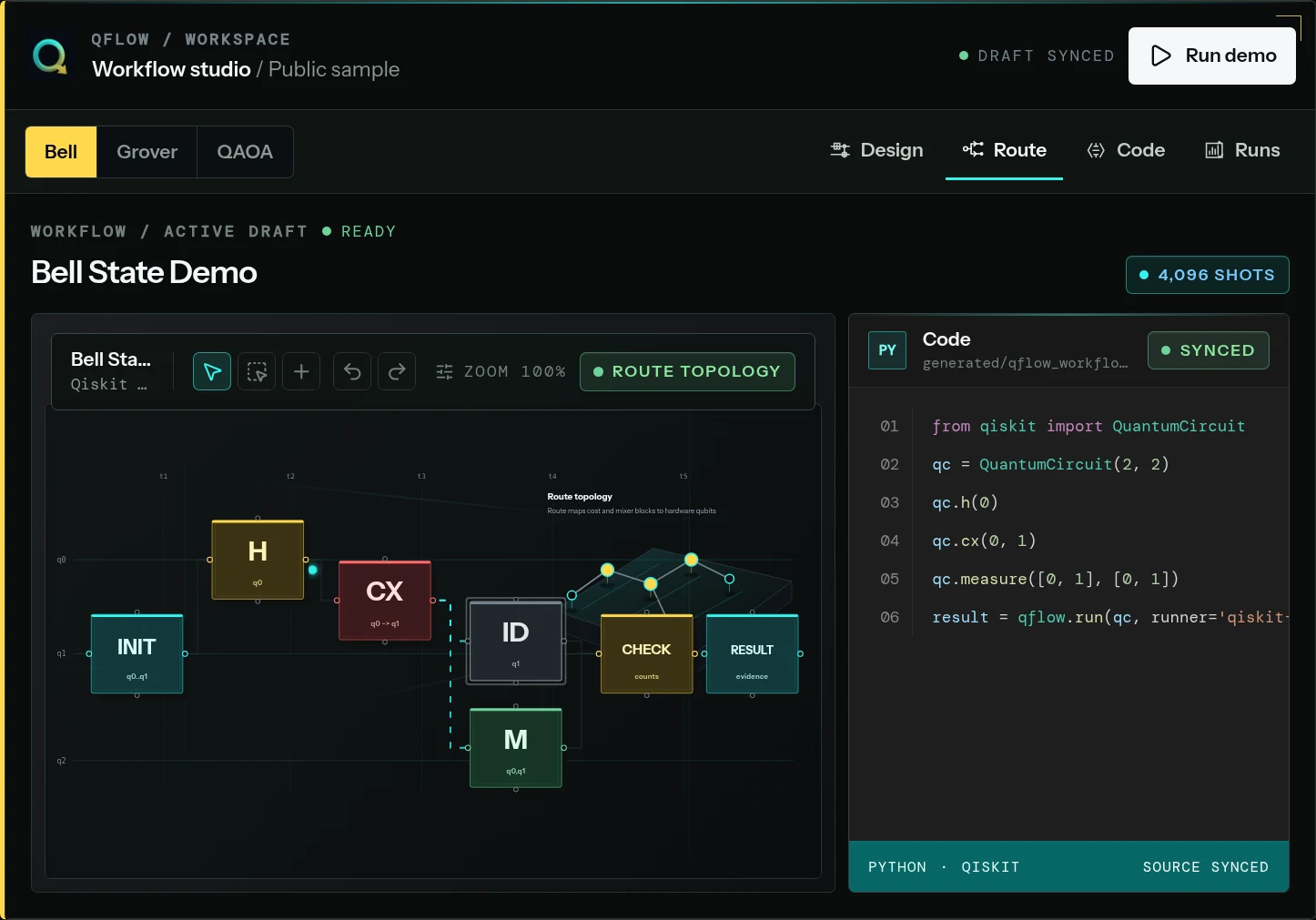
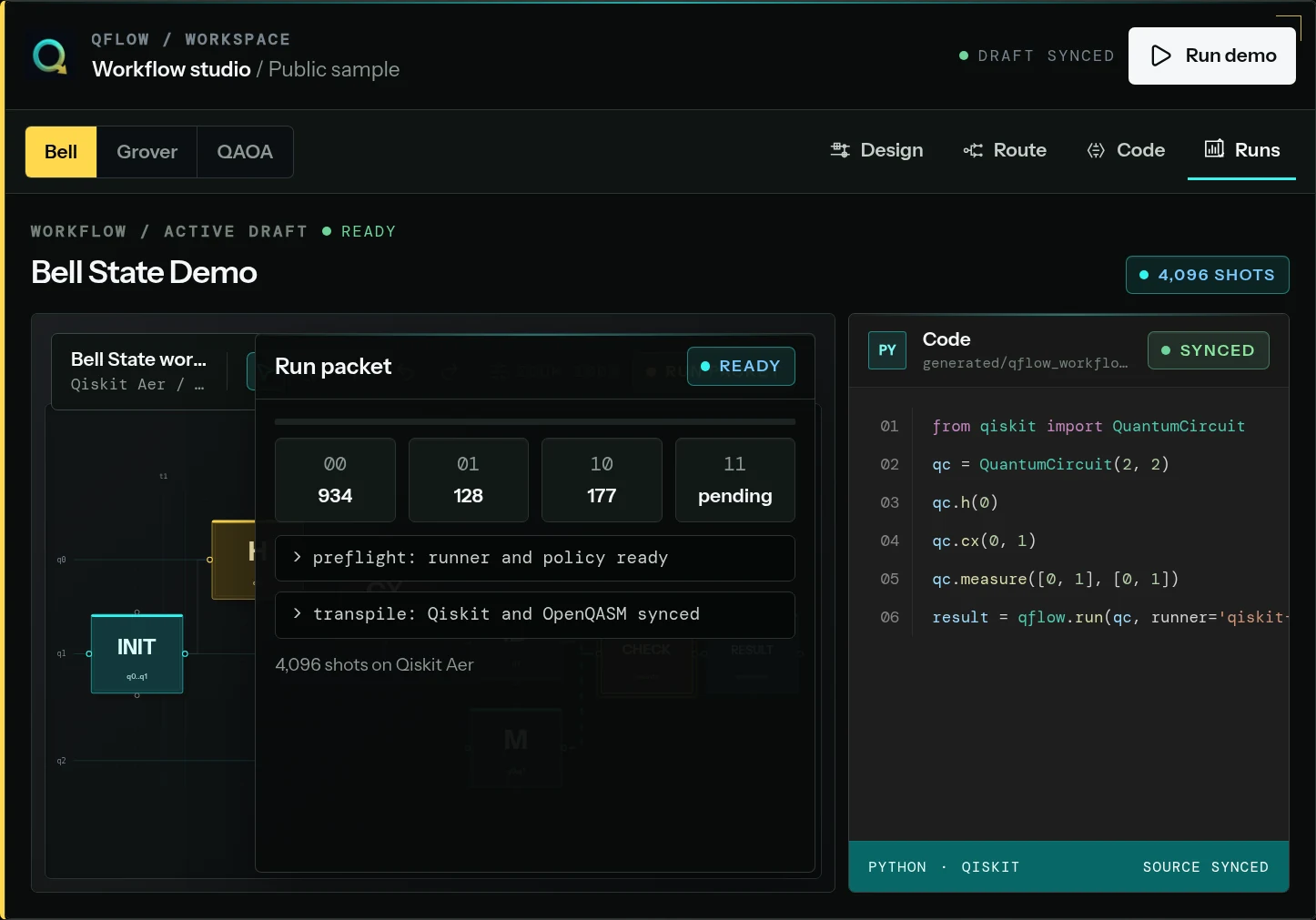
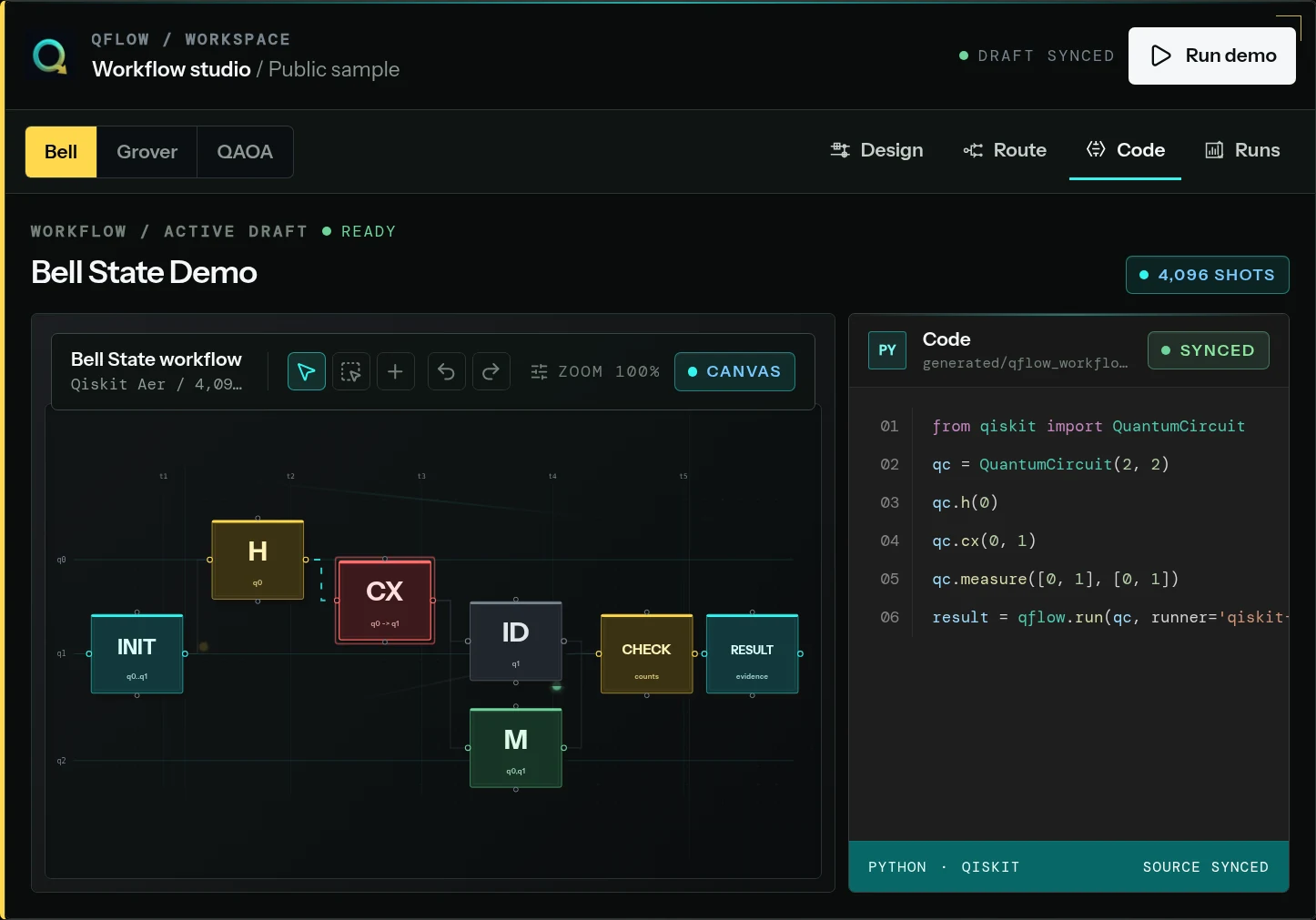
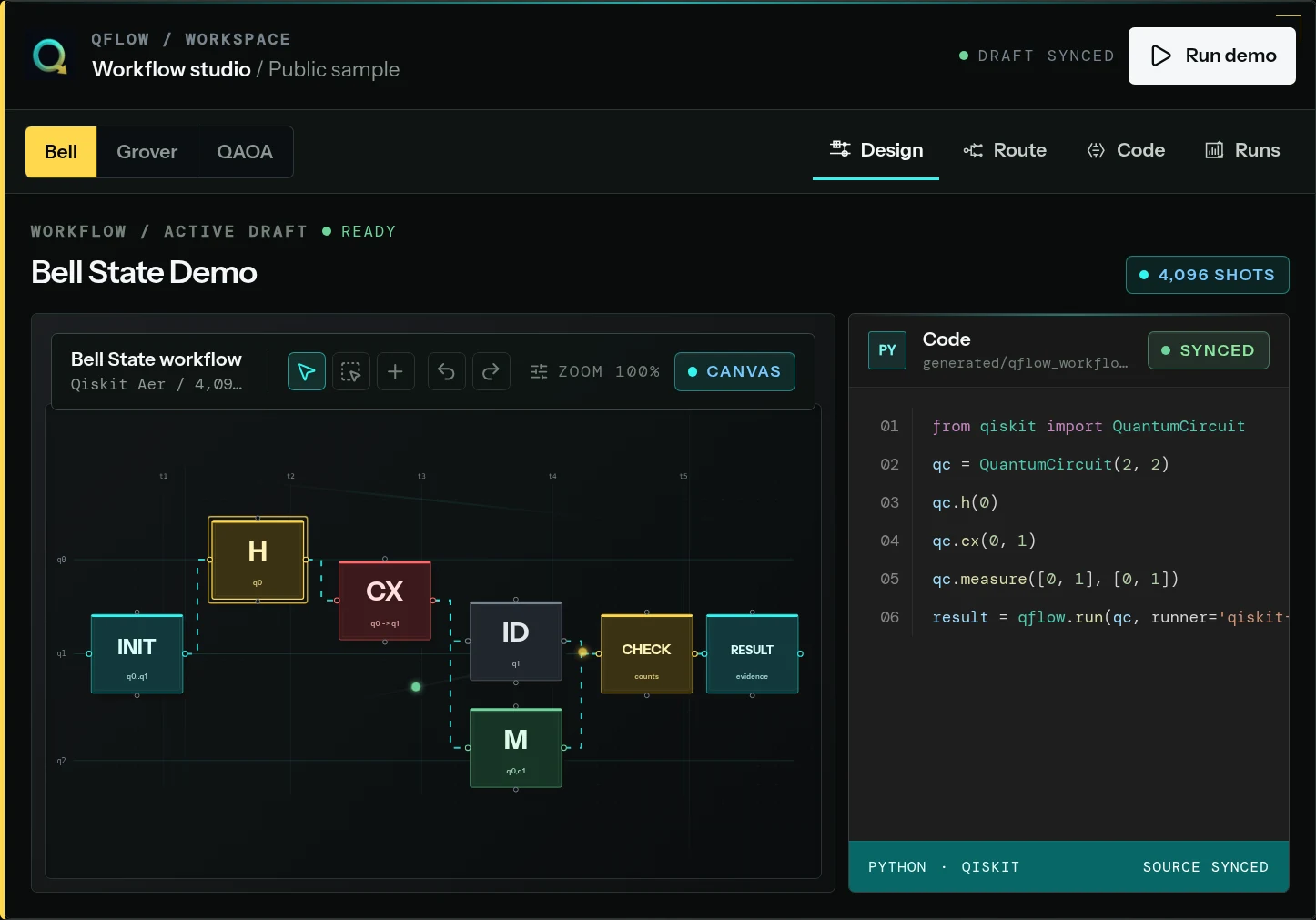
QFlow Studio’s visual canvas and generated-code view can help a learner or reviewer connect circuit intent to Qiskit and OpenQASM artifacts. For Runtime work, teams should attach the selected primitive, PUB inputs, options, route, returned result, and review rule as supplemental evidence; the public generated-code documentation does not claim that all of those fields are captured automatically.
This guide does not claim that every Qiskit Runtime primitive—especially beta Executor—is callable from QFlow. Live submission support must be verified against QFlow’s dated integration matrix and tested with the user’s independent provider account. Where a path is not implemented, QFlow should present the primitive as ecosystem context or an exported-code destination, not as an available run button.
Practical takeaways
01
Use SamplerV2 when measured register samples and bitstrings answer the question.
02
Use EstimatorV2 when observable expectation values and their uncertainty are the intended result.
03
Treat Executor as a beta directed-execution interface, not as a generally available upgrade path.
04
Preserve PUBs, target-aware artifacts, options, shots or precision, raw results, and metadata.
05
Verify QFlow’s live integration status instead of inferring submission support from generated source.
RA · Reference annexDefinitions, recurring questions, editorial method, and primary sources.Inspect
The analysis above carries the main reading flow. This reference layer keeps terminology, recurring questions, editorial method, and primary sources available without interrupting the argument.
Field questions
Program questions behind Sampler vs Estimator vs Executor: choose the result your workflow needs..
Q01What is the difference between Qiskit Sampler and Estimator?
SamplerV2 returns shot-based output-register samples from measured circuits. EstimatorV2 estimates expectation values for specified observables and returns uncertainty information. The correct choice depends on the quantity the experiment needs.
Q02Is Qiskit Executor production-ready?
IBM’s current documentation labels Executor as beta. Its interfaces and operational boundaries should be rechecked before production use, and it should not be presented as generally available without that qualification.
Q03Do Qiskit Runtime primitives accept any abstract circuit?
Hardware submissions require circuits compatible with the target instruction set and connectivity. The workflow should preserve both the abstract circuit and the target-aware transpiled artifact, plus observable layout where Estimator requires it.
Q04Does QFlow Studio support Sampler, Estimator, and Executor submissions?
This guide does not assert that. QFlow can document the concepts and generate inspectable source, but live primitive support must be confirmed on the current integration status page for the selected route.
Editorial record
How Sampler vs Estimator vs Executor: choose the result your workflow needs. was checked.
- Editorial owner
- Neura Parse Research
- Last verified
- July 20, 2026
- Method
- Synthesis of the dated primary and official records listed below, checked against the operating question in this note.
- Scope limit
- Planning analysis—not certification, customer performance evidence, procurement advice, or a claim of production readiness.
SRSources reviewed
8 records