Abstract
Backend selection is a constrained matching problem. The useful question is not which QPU ranks first in general, but which eligible route best fits this circuit, observable, precision target, access boundary, and experiment window.
Gap map
A backend decision is a sequence of exclusions and tradeoffs.
Eligibility comes first; quality, time, and cost comparisons only make sense among routes that can execute the intended workload.
Circuit contract
- Qubits and classical bits
- Operations and control flow
- Observable and precision
- Depth after mapping
Eligibility
- Account and region access
- Supported input path
- Topology and native gates
- Operational status
Tradeoffs
- Calibration snapshot
- Queue and execution mode
- Shots and usage budget
- Drift window
Decision receipt
- Chosen route and timestamp
- Rejected alternatives
- Acceptance threshold
- Fallback and recheck rule
There is no context-free best quantum backend.
A backend can have more qubits, a shorter visible queue, or a strong calibration metric and still be a poor route for a particular circuit. The circuit may map badly to its coupling graph, use an unsupported operation, require an execution mode unavailable to the account, or exceed the experiment's time and usage budget after transpilation.
Treat backend selection as a versioned decision rather than a leaderboard. The decision should name the workload, eligible routes, data timestamp, comparison rule, reason for selection, and the condition that triggers a new selection pass.
TD · Technical depth6 supporting chapters and the working checklist.Read deeper
Eliminate routes that cannot execute the workload contract.
Begin with hard constraints: accessible provider account, region or workspace, operational target, supported program format, qubit requirement, native instruction support, control-flow requirements, and payload limits. A route that fails one of these gates is not a candidate regardless of headline performance.
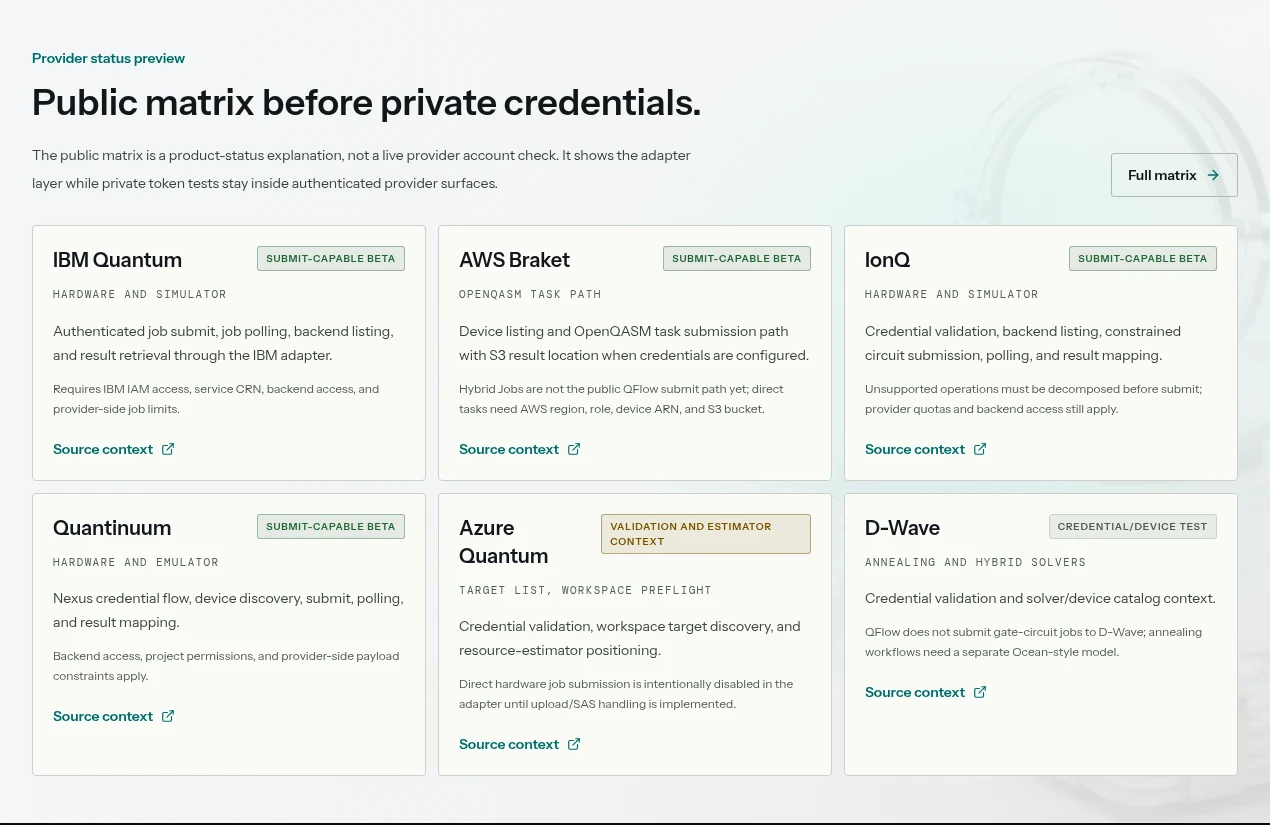
QFlow's public matrix deliberately separates submit-capable beta, validation, preflight, credential-test, local-simulator, and planned states. That status is product evidence, not proof that a particular user has provider entitlement, quota, queue priority, pricing approval, or device access.
- Record provider and adapter status separately from account entitlement.
- Inspect the mapped circuit, not only the logical circuit.
- Reject unsupported operations before paid submission.
- Keep simulator availability as an explicit fallback route.
Read calibration through the mapped circuit.
Backend properties such as two-qubit operation error, readout error, qubit lifetime, topology, and calibration time provide context. They do not collapse into one universally valid quality score. A sparse circuit may care about a small high-quality connected subgraph; a deeper circuit may be dominated by routing overhead and two-qubit layers.
Calibration is also time-bound. Preserve the timestamp and, where available, historical properties used for the decision. If the experiment runs after a long queue or a new calibration, the selection rationale may need to be re-evaluated rather than silently reused.
Queue depth is only one part of time to evidence.
Pending jobs can help estimate near-term delay, but wall-clock completion also depends on compilation, shots, requested precision, mitigation overhead, job packaging, and whether the workload uses job, batch, or session behavior. The least-busy eligible backend is a convenience heuristic, not a scientific selection rule.
For iterative workloads, execution mode can affect drift and total elapsed time. For independent comparisons, a batch can keep related jobs closer together. For a single small request, job mode may be simplest. Provider documentation and account terms remain authoritative because access and usage models change.
Keep a simulator and classical expectation beside hardware.
A simulator-first pass catches source, parameter, bit-ordering, measurement, and expected-output errors before hardware routing. It also provides a reference distribution or expectation value that helps the team distinguish an implementation failure from hardware behavior.
Simulation is not a promise of hardware fidelity. The workflow should say which simulator and noise assumptions were used and which hardware-specific question justifies leaving the simulator route.
Preserve why this route was chosen and why others were rejected.
For a backend decision, use QFlow's documented source, provider-route, run, trace, result, and reviewer-note fields as the core record. Attach the mapped-circuit summary, candidate routes, access check, calibration timestamp, topology fit, queue observation, execution mode, shots or precision, usage boundary, chosen route, and fallback when those details affect the decision; the public manifest does not present every one of these as a dedicated first-class field. Credentials and billing details stay outside reviewer-safe evidence.
Rejected candidates matter. They show whether a later result came from a deliberate tradeoff or from selecting the first visible device. They also make future rerouting faster when access, calibration, queues, or provider support changes.
Re-select when a material assumption changes.
Selection expires when the circuit changes materially, the target becomes unavailable, calibration becomes stale for the experiment, the queue breaches the time window, the usage estimate crosses budget, or the account's execution options change. The workflow should name these triggers before submission.
A backend result supports only the declared experiment under its recorded conditions. It does not establish provider superiority, universal device ranking, production readiness, or quantum advantage.
Practical takeaways
01
Apply access and capability gates before comparing performance metrics.
02
Interpret topology and calibration through the mapped circuit, not as a universal score.
03
Include shots, precision, mitigation, execution mode, queue, and budget in time-to-evidence planning.
04
Preserve rejected routes, timestamps, and reselection triggers in the workflow record.
05
Never turn QFlow adapter status or a provider metric into an entitlement, endorsement, or universal ranking claim.
RA · Reference annexDefinitions, recurring questions, editorial method, and primary sources.Inspect
The analysis above carries the main reading flow. This reference layer keeps terminology, recurring questions, editorial method, and primary sources available without interrupting the argument.
Field questions
Program questions behind Selecting a quantum backend for a specific circuit..
Q01Is the least-busy QPU automatically the best backend?
No. Least busy only describes a queue signal among accessible backends at a point in time. Circuit mapping, supported operations, topology, calibration, execution mode, precision, usage, and the experiment's acceptance rule can make another eligible route more appropriate.
Q02Which quantum backend metric matters most?
There is no universal single metric. Start with hard eligibility, then evaluate the mapped circuit against topology, relevant operation and readout properties, calibration time, queue, execution mode, shots or precision, and budget.
Q03Does QFlow Studio guarantee access to listed providers?
No. QFlow publishes status-labelled adapter context. Provider accounts, credentials, plans, regions, quotas, pricing, permissions, queues, and backend eligibility remain independently controlled by each provider.
Q04When should a team repeat backend selection?
Repeat it when the mapped circuit, target status, calibration context, access, queue window, execution mode, precision target, mitigation plan, or usage budget changes materially.
Editorial record
How Selecting a quantum backend for a specific circuit. was checked.
- Editorial owner
- Neura Parse Research
- Last verified
- July 20, 2026
- Method
- Synthesis of the dated primary and official records listed below, checked against the operating question in this note.
- Scope limit
- Planning analysis—not certification, customer performance evidence, procurement advice, or a claim of production readiness.
SRSources reviewed
5 records