
Abstract
A physical-qubit or runtime number is not portable without its assumptions. The useful artifact is a set of comparable estimate scenarios and a record of which dependency would have to improve before the workload becomes plausible.
Gap map
A resource estimate is a chain of models.
Every physical output must remain traceable to the application, architecture, error-correction, factory, transform, and error-budget assumptions that produced it.
Application
- Algorithm and instance
- Logical operations
- Measurements and rotations
- Classical interaction
Architecture
- Physical gate times
- Physical error rates
- Connectivity and control
- Cycle assumptions
Fault tolerance
- QEC code and distance
- Error budget allocation
- Factory protocol
- Layout and routing
Evidence
- Physical qubits
- Runtime and error
- Pareto scenarios
- Sensitivity and next gate
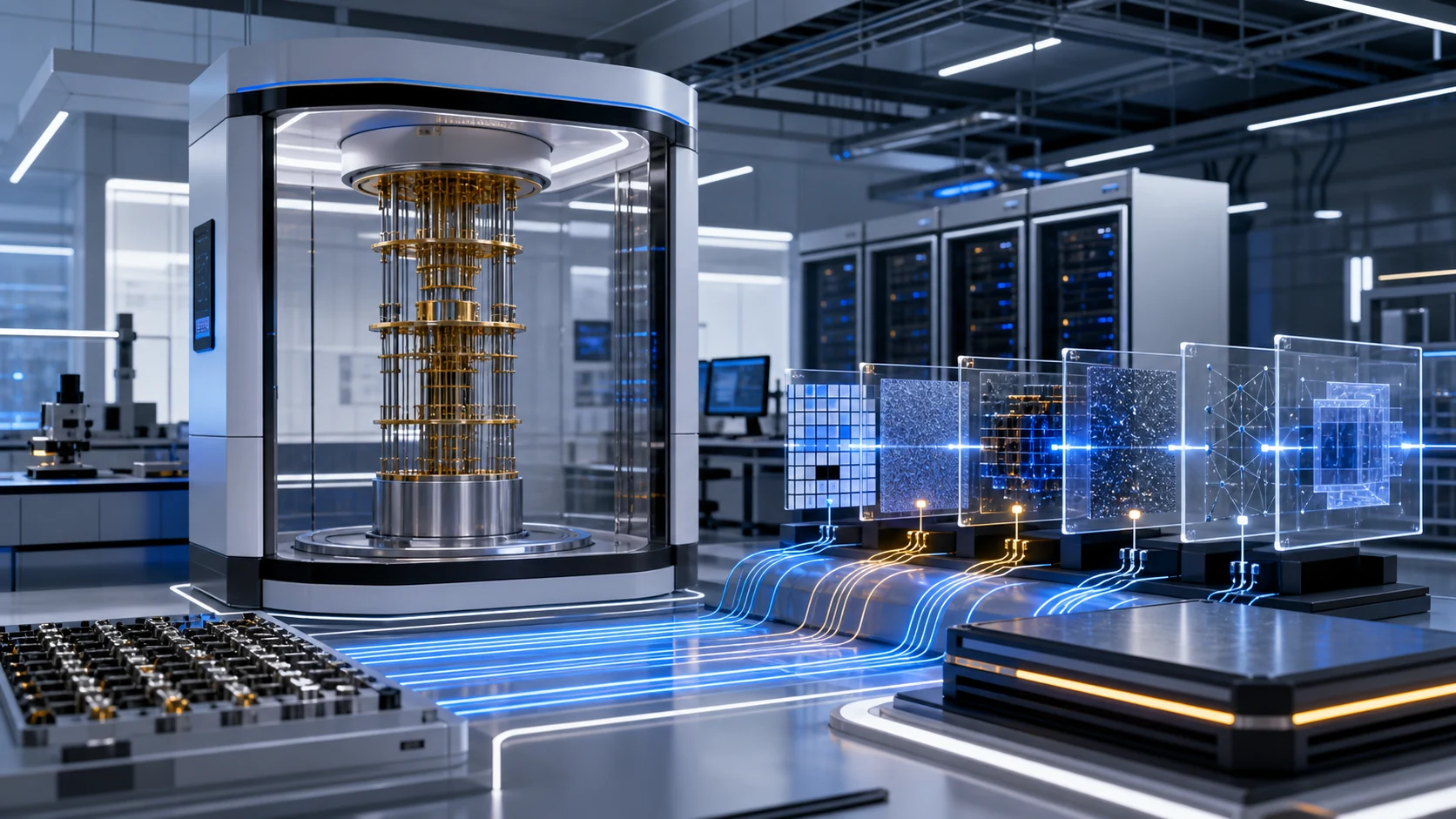
The output describes a modeled fault-tolerant machine, not today's QPU.
Fault-tolerant resource estimation asks what resources an application could require under a specified future or hypothetical architecture and error-correction design. It is not a benchmark of a currently available noisy processor, a delivery date, or proof that the application will outperform a classical method.
Keep three records separate: current hardware execution evidence, fault-tolerant resource scenarios, and provider roadmaps. They can inform one programme decision, but none validates the others.
TD · Technical depth6 supporting chapters and the working checklist.Read deeper
Define the exact workload before counting logical resources.
Name the algorithm variant, problem instance, input representation, target observable or output, success probability, precision, repetition rule, and classical pre- and post-processing. A toy kernel without data preparation, optimization iterations, or sampling can understate the end-to-end requirement.
Preserve the application source or intermediate representation and a logical-resource summary: qubits, Clifford operations, non-Clifford operations, arbitrary rotations, measurements, depth or dependency structure, and any adaptive classical control relevant to the estimator.
Make physical assumptions inspectable and replaceable.
Physical gate and measurement times, error rates, connectivity, cycle behavior, instruction support, and control assumptions shape the physical estimate. Built-in hardware models are useful comparison scenarios, not guaranteed product specifications.
Version the architecture model independently from the application. That separation lets a team rerun the same logical workload against improved hardware assumptions without silently changing the algorithm at the same time.
Error correction and magic-state production often dominate the answer.
Specify the error-correction code, code-distance selection rule, logical error target, decoding and cycle assumptions, layout, routing, and how the total error budget is divided. For algorithms with many non-Clifford operations, factory type, throughput, copies, distillation rounds, and target state error can drive qubit and runtime requirements.
Do not hide factories behind one physical-qubit total. Report data-qubit, routing, factory, and other overhead categories where the tool exposes them so reviewers can see which engineering dependency dominates.
Compilation choices are resource assumptions too.
Rotation synthesis, gate decomposition, layout, scheduling, parallelism, measurement strategy, and factory scheduling can move an estimate substantially. Preserve tool version, transform configuration, approximation tolerance, and the logical trace or summary used by the estimator.
A lower number produced by a different transform is not automatically an improvement. Confirm that both scenarios implement the same application contract and success criterion.
Prefer Pareto frontiers and sensitivity sweeps to one headline number.
Microsoft's current resource estimator exposes Pareto-optimal tradeoffs between physical qubits and runtime under a maximum error threshold. That shape is more useful than one selected point because programme decisions usually have constraints on both space and time.
Sweep the assumptions most likely to change the decision: physical error rate, cycle time, error budget, synthesis tolerance, QEC family, factory count, and application size. Report elasticities or scenario deltas so a reviewer can see which improvement matters and which barely changes feasibility.
estimate = f(application, architecture, QEC, factories, transforms, error_budget)Turn each estimate into a versioned decision object.
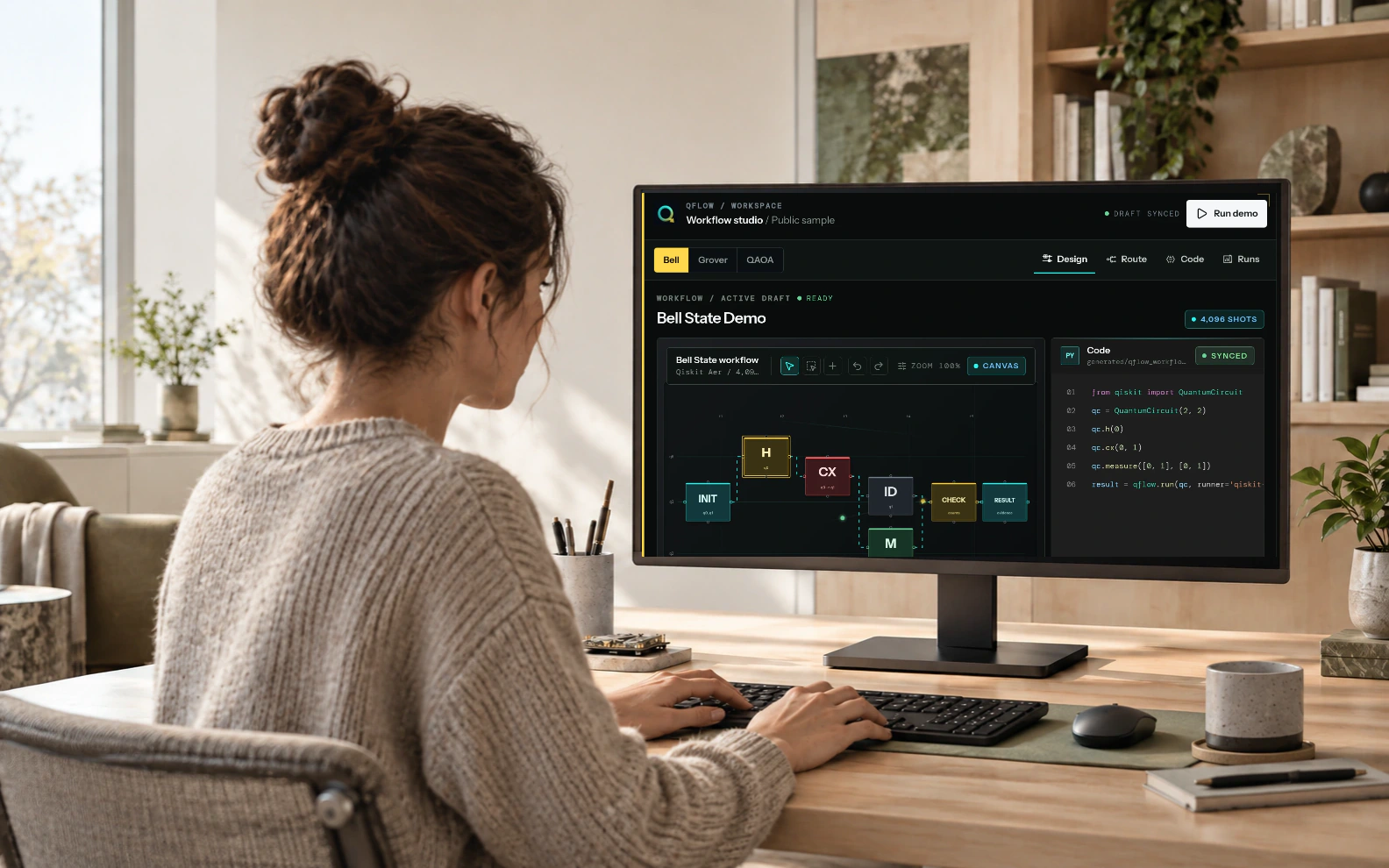
Use QFlow's documented workflow, source, route, trace, export, and reviewer-note fields as a container for the estimate decision, then link or attach the application source, estimator version, logical summary, architecture model, QEC and factory choices, error budget, transform configuration, result table, Pareto plot, sensitivity runs, classical baseline, and next gate as supporting artifacts.
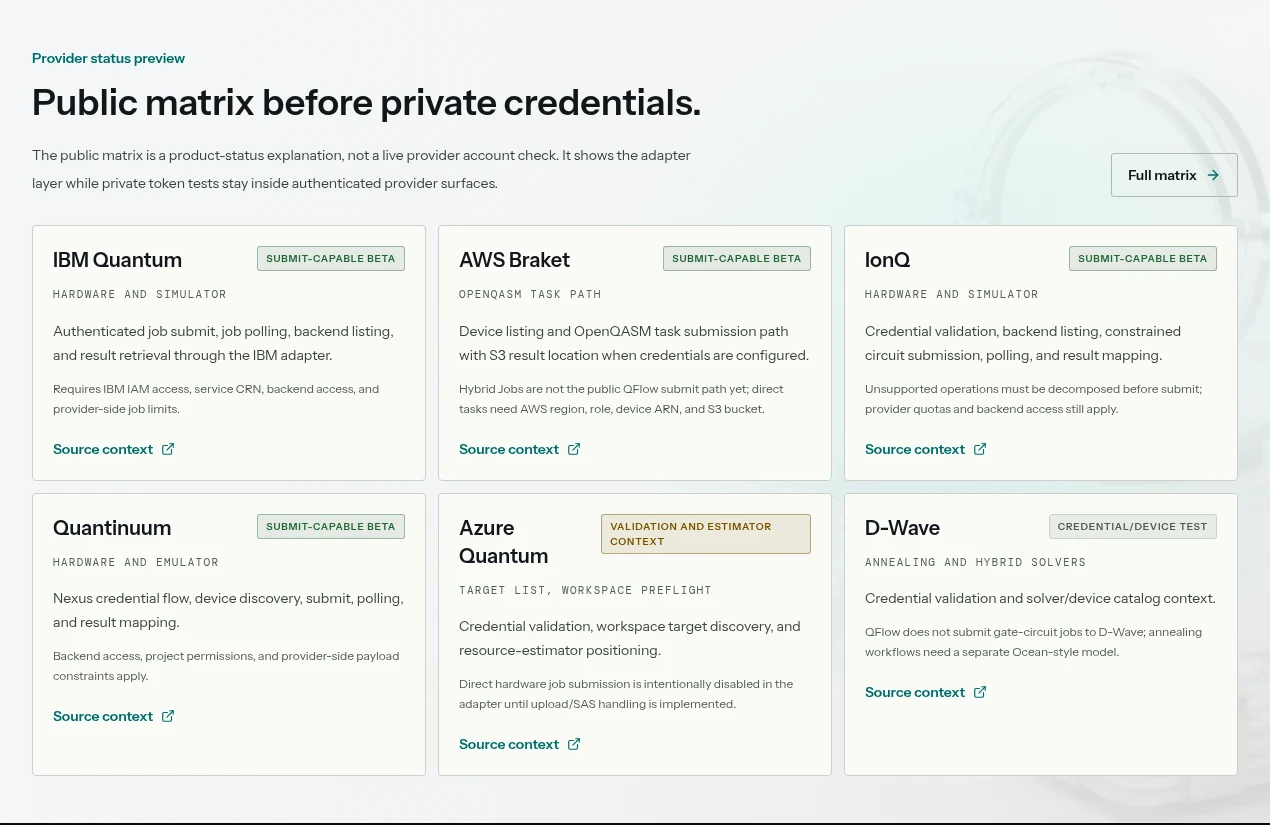
QFlow's public status matrix currently describes Azure Quantum as validation and resource-estimator context. It does not claim that QFlow executes the Microsoft Quantum resource estimator or exposes every assumption above as a dedicated first-class field. Run and verify the estimate with the authoritative QDK tooling, preserve its export, and label the QFlow layer as evidence context.
The next gate may be to improve the formulation, validate a logical count, compare another architecture, wait for a hardware milestone, or stop. An assumption-bound estimate can support those decisions without being presented as current-QPU performance or a guaranteed roadmap outcome.
Practical takeaways
01
Separate current hardware evidence from modeled fault-tolerant scenarios.
02
Count the end-to-end application, including repetition and classical orchestration assumptions.
03
Expose architecture, QEC, factory, transform, and error-budget inputs beside every output.
04
Use Pareto and sensitivity analysis instead of promoting one physical-qubit number.
05
Treat the estimate as a decision record, not a hardware forecast or advantage claim.
RA · Reference annexDefinitions, recurring questions, editorial method, and primary sources.Inspect
The analysis above carries the main reading flow. This reference layer keeps terminology, recurring questions, editorial method, and primary sources available without interrupting the argument.
Field questions
Program questions behind Fault-tolerant quantum resource estimation: assumptions and budgets..
Q01Does a fault-tolerant resource estimate predict current QPU performance?
No. It models resources for a specified fault-tolerant architecture, error-correction scheme, factory design, error budget, and application. Current noisy-QPU results and provider roadmaps are separate evidence surfaces.
Q02Why can two resource estimators produce different numbers?
They may use different application decompositions, physical parameters, QEC codes, logical error targets, factory protocols, layouts, scheduling assumptions, transforms, or approximation tolerances. Compare inputs before comparing outputs.
Q03Which resource-estimation output should a team publish?
Publish a scenario table or Pareto frontier with the application, model versions, assumptions, physical qubits, runtime, error target, factory contribution, sensitivity, and limitations. Avoid a detached headline number.
Q04Can resource estimation prove quantum advantage?
No. It can test whether a quantum formulation looks plausible under stated hardware and fault-tolerance assumptions. An advantage claim also needs a fair end-to-end classical baseline, comparable success criteria, and validated execution evidence.
Editorial record
How Fault-tolerant quantum resource estimation: assumptions and budgets. was checked.
- Editorial owner
- Neura Parse Research
- Last verified
- July 20, 2026
- Method
- Synthesis of the dated primary and official records listed below, checked against the operating question in this note.
- Scope limit
- Planning analysis—not certification, customer performance evidence, procurement advice, or a claim of production readiness.
SRSources reviewed
6 records