Frontend
Next.js App RouterReactTypeScriptTailwindshadcn/uiTanStack Query
TaskNebula architecture
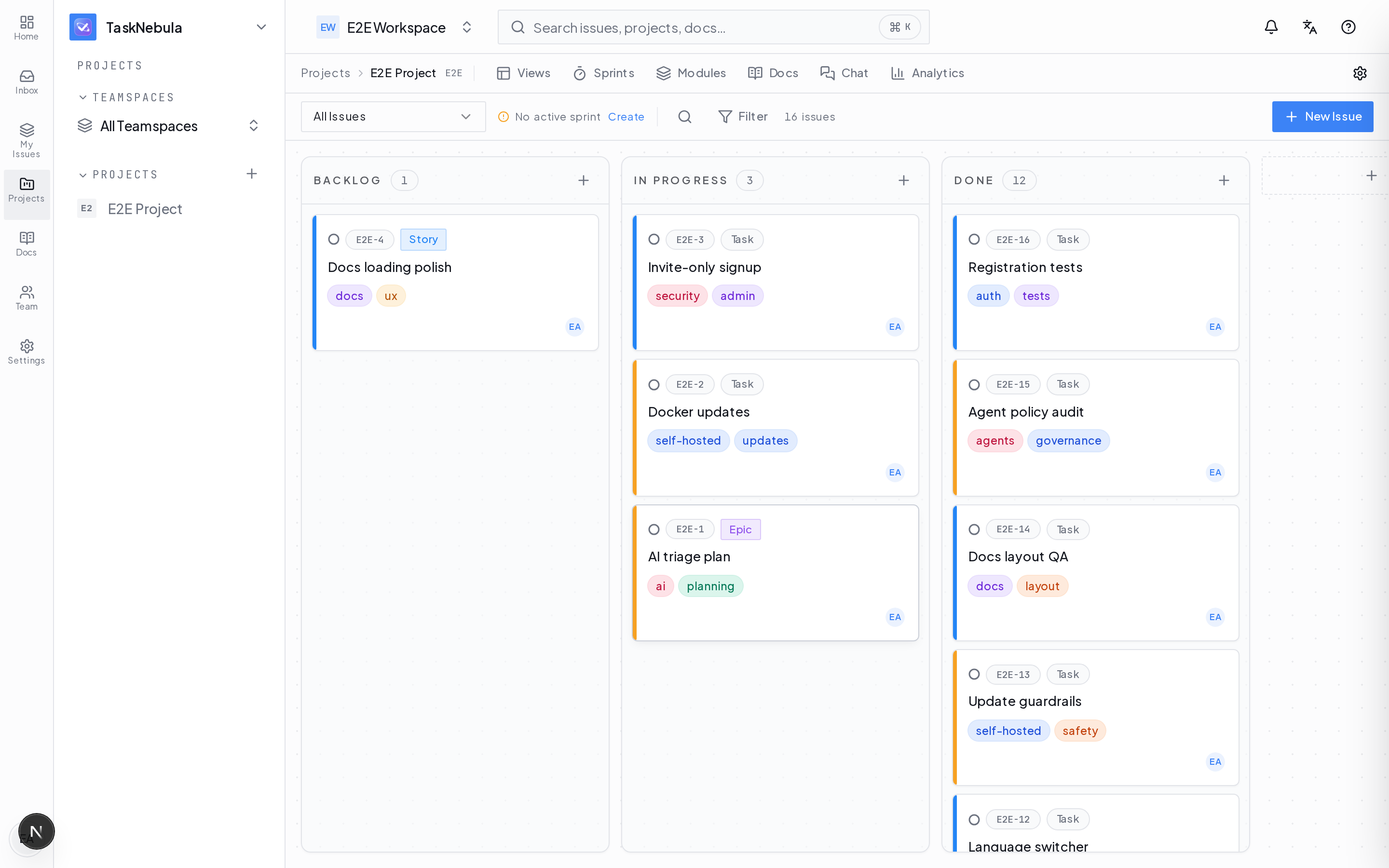
TaskNebula uses a precise, conventional stack: Next.js, PostgreSQL with pgvector, Redis, realtime collaboration, optional LiveKit, Docker Compose, localization, and a public roadmap.
Work graph on PostgresSSE realtimePublic roadmap
01Stack map
TaskNebula places AI-agent governance over infrastructure many teams already operate: Next.js, PostgreSQL, Redis, optional LiveKit, and Docker Compose.
02System model
The roadmap keeps the boundary clear: no chat, video, or wiki super-app; no full standalone calendar; and no native-mobile-first detour. The work graph remains the core.
01
TaskNebula ships as a standalone Next.js web container with App Router, React, route handlers, and Docker-first runtime assumptions.
02
The roadmap explicitly positions TaskNebula as a self-hostable Linear control plane that avoids sprawling infrastructure and centers the work graph around PostgreSQL.
03
Issue create/update/delete events use SSE with Redis pub/sub and in-process fallback for single-instance installs. Yjs supports collaborative editing where wired.
04
The app ships 30 languages, browser/device auto-detection, native-name language switching, and RTL support for Arabic and Hebrew.
05
RBAC, issue security levels, audit-log action types, signed webhooks, AGENTOWNERS, and approval gates are part of the public technical surface.
06
The roadmap names shipped, partial, and open work, including tenant isolation, API-key auth, pagination, MCP, importer depth, and governance completion.
localized app
Zod + auth
issues + embeddings
SSE events
opt-in BYOK
03Roadmap posture
Technical evaluators can distinguish available capability from partial implementation and open roadmap work without inheriting an inflated maturity claim.
Foundation
Labels, components, release records, resolution, issue rank, workflow enforcement, boards, structured queries, notifications, tenant isolation, API keys, pagination, and scale floor.
Next
Deeper code-host links, importer improvements, release notes, semantic search, Ask-AI completion, agent approval queues, MCP expansion, and coding-agent handoffs.
Longer term
Custom hierarchy, field schemes, permission enforcement, portfolio plans, SLAs, configurable dashboards, proactive risk detection, and agent builder direction.
04Evaluation notes
Documented gaps and staged work remain part of the evaluation; TaskNebula does not claim finished enterprise parity across every surface.
Ask/RAG, embeddings, MCP, agent engine, analytics, and importer work have visible roadmap follow-through.
Tenant isolation, API-key scopes, pagination, type-safety restoration, and governance completion are named as platform prerequisites.
Self-hostable Linear, control plane for AI agents, Postgres-first operations, and no super-app sprawl.
Run it yourself
TaskNebula is a self-hostable project-management control plane for teams that want inspectable operations instead of another black-box SaaS.