
Abstract
The rubric makes reasoning visible before and after execution. It gives credit for an honestly diagnosed failure and withholds credit from an unexplained successful histogram.
Gap map
The rubric follows the full learning record.
Scores attach to inspectable artifacts, not to whether a provider returned a green status or an expected-looking chart.
Before build
- Prediction — 10
- Assumptions and expected output
- Success and failure checks
Implementation
- Circuit and source — 20
- Gate, parameter, bit mapping
- Visual-to-code explanation
Run and reason
- Execution record — 15
- Interpretation — 20
- Limitations — 10
Improve and prove
- Revision — 10
- Evidence and provenance — 15
- Reviewer-safe submission
A completed quantum job is not proof of understanding.
A learner can run copied code and receive plausible counts without understanding gate order, bit mapping, sampling, source semantics, backend choice, or limitations. Conversely, a failed run can reveal strong understanding when the learner identifies the fault, tests a hypothesis, and records a justified revision.
Score the evidence trail. The rubric should reward what the learner predicted, built, inspected, executed, inferred, questioned, and improved—not the prestige of the provider or the cosmetic quality of one chart.

TD · Technical depth6 supporting chapters and the working checklist.Read deeper
Use seven dimensions with visible weights.
A practical starting model totals 100 points: prediction 10; circuit and source correctness 20; execution record 15; result interpretation 20; limitations 10; revision 10; evidence and provenance 15. Institutions should adapt weights to the learning outcomes, accessibility needs, assignment level, and academic policy.
Publish descriptors at four performance levels—exemplary, proficient, developing, and insufficient—before the lab. A point total without descriptors invites inconsistent grading and gives learners little guidance about how to improve.
score = prediction(10) + implementation(20) + execution(15) + interpretation(20) + limitations(10) + revision(10) + evidence(15)Assess the mental model before rewarding syntax.
Prediction earns credit when the learner states the expected qualitative or quantitative behavior, assumptions, and a falsifying observation before execution. It should be specific enough to compare with the result without demanding that finite-shot output match an exact distribution.
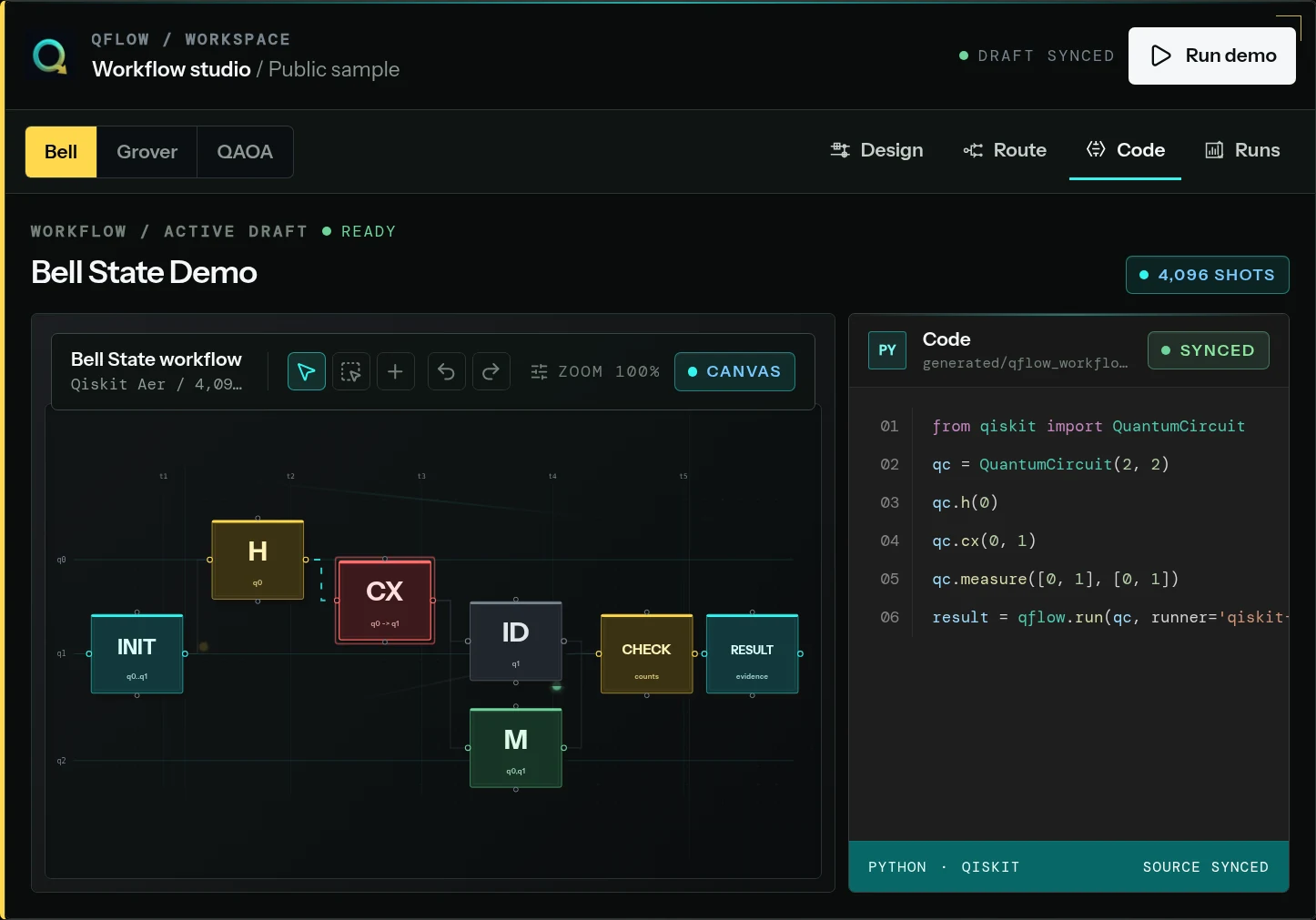
Circuit and source correctness covers gate sequence, controls, parameters, qubit and classical-bit mapping, measurement placement, and an explanation of how the visual workflow corresponds to generated Qiskit, Cirq, or OpenQASM where used. Correct code without an explanation is not full credit.
Separate what ran from what the learner concludes.
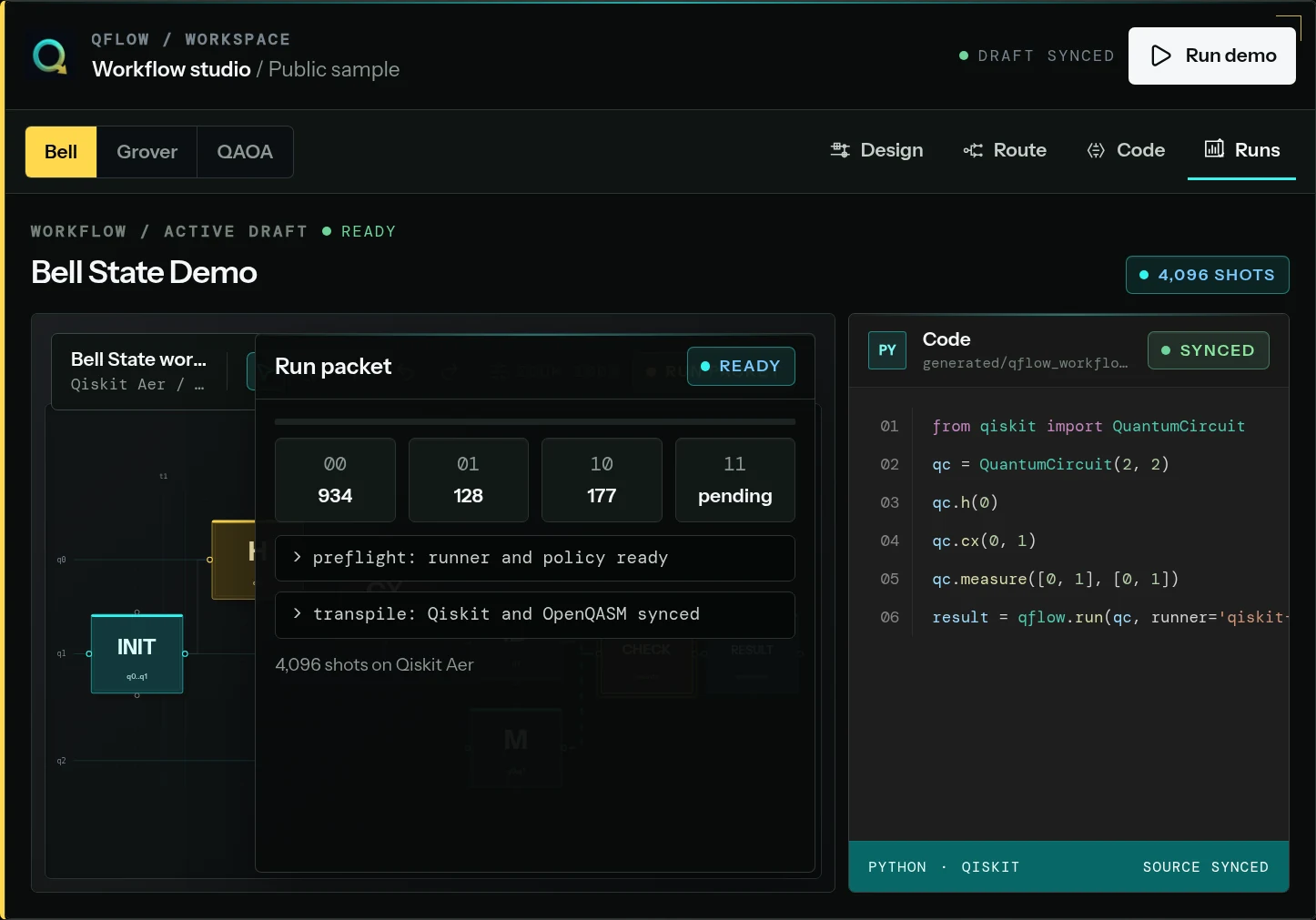
Execution evidence should identify workflow and source snapshot, simulator or provider route, non-secret configuration, shots or precision, timestamps, result, errors or retries, and any transformation applied after the raw output. Credentials, billing records, private emails, and hidden administration notes do not belong in a shared submission.
Interpretation compares the result with the prediction or baseline, explains sampling and noise where relevant, distinguishes observation from inference, and avoids an advantage claim from a classroom-scale demonstration. A polished chart with no reasoning receives limited credit.
Require learners to name what the result cannot show.
Limitations can include finite shots, simulator assumptions, mapping overhead, device noise, stale calibration context, small problem size, missing baseline, unsupported operations, or uncertainty about an interpretation. The strongest response connects each limitation to the conclusion it constrains.
Revision asks the learner to act on feedback or evidence: correct the source, change a test, add a baseline, rerun with a justified setting, or explain why another run would not be useful. Revision credit should reflect the quality of the reasoning, not simply whether the second result looks better.
Moderate the rubric across assignments and graders.
Before marking a cohort, instructors and teaching assistants should score a small shared sample, compare disagreements, clarify descriptors, and document accepted variations. Repeat moderation when the lab changes from simulator-only work to provider context or from foundation circuits to hybrid algorithms.
Use anonymized exemplars where policy permits. Show one strong explanation, one technically correct but under-explained submission, and one responsibly diagnosed failure so learners understand that the rubric values evidence rather than a predetermined output.
QFlow can preserve assessment evidence; the institution owns the grade.
QFlow Academy can connect lesson state, workflow, generated source, run checks, attempts, feedback, progress, and reviewer-safe evidence. Teachers use the same learner experience as other members; their additional documented permission concerns academic-source review, and the review interface itself remains admin-gated. Institutional teaching guidance, grading, and appeals stay outside that product-role claim.
QFlow does not determine academic credit, accommodations, misconduct findings, appeals, professional competence, accreditation, or provider certification. IBM Quantum Learning and Qiskit resources remain independent learning materials; their use does not create IBM endorsement or accreditation of the rubric.
Practical takeaways
01
Grade the reasoning trail rather than a successful job status or expected-looking histogram.
02
Publish seven weighted dimensions and four performance-level descriptors before the assignment.
03
Keep execution evidence distinct from interpretation and require explicit limitations.
04
Award meaningful credit for diagnosis and revision, including responsibly analyzed failed runs.
05
Keep grading, credit, accreditation, privacy, accommodations, and appeals under institutional authority.
RA · Reference annexDefinitions, recurring questions, editorial method, and primary sources.Inspect
The analysis above carries the main reading flow. This reference layer keeps terminology, recurring questions, editorial method, and primary sources available without interrupting the argument.
Field questions
Program questions behind A quantum computing lab rubric should reward prediction, reasoning, revision, and evidence..
Q01Are the proposed quantum lab rubric weights mandatory?
No. The 100-point model is an adaptable starting point. Institutions should align weights and descriptors with course outcomes, assignment level, accessibility, academic regulations, and moderation practice.
Q02Can a failed quantum run receive a strong grade?
Yes. A learner can earn substantial credit by preserving the failure, diagnosing it with evidence, distinguishing implementation from hardware or access issues, proposing a justified test, and documenting what changed. Fabricated or unexplained success should not score higher.
Q03Must students run on quantum hardware to satisfy the rubric?
No. The rubric can be completed with simulator evidence. Hardware should only be required when it supports a declared learning outcome and the course provides authorized access, usage guidance, privacy protection, approval, and a fallback.
Q04Does QFlow or IBM accredit this assessment rubric?
No. QFlow provides workflow and learning evidence features, and IBM materials are independent educational resources. Grades, credit, accreditation, accommodations, appeals, and academic standards remain with the responsible institution and applicable bodies.
Editorial record
How A quantum computing lab rubric should reward prediction, reasoning, revision, and evidence. was checked.
- Editorial owner
- Neura Parse Research
- Last verified
- July 20, 2026
- Method
- Synthesis of the dated primary and official records listed below, checked against the operating question in this note.
- Scope limit
- Planning analysis—not certification, customer performance evidence, procurement advice, or a claim of production readiness.
SRSources reviewed
7 records