Abstract
A practical timing plan for robotic AI: identify where an observation waits, compare local and remote processing, and preserve quality and authority in the result.
Gap map
One observation, several timing boundaries
An evaluation model. The intervals depend on the chosen workload, clock assumptions and target; no measured result is shown.
Observe
- Sensor capture
- Preprocessing
- Source timestamp
Compute
- Transfer
- Queue wait
- Inference
- Postprocessing
Act
- Review if required
- Command admission
- Device receipt
Verify
- Task progress
- Outcome evidence
- Unresolved state
Start with the decision the timing is supposed to support.
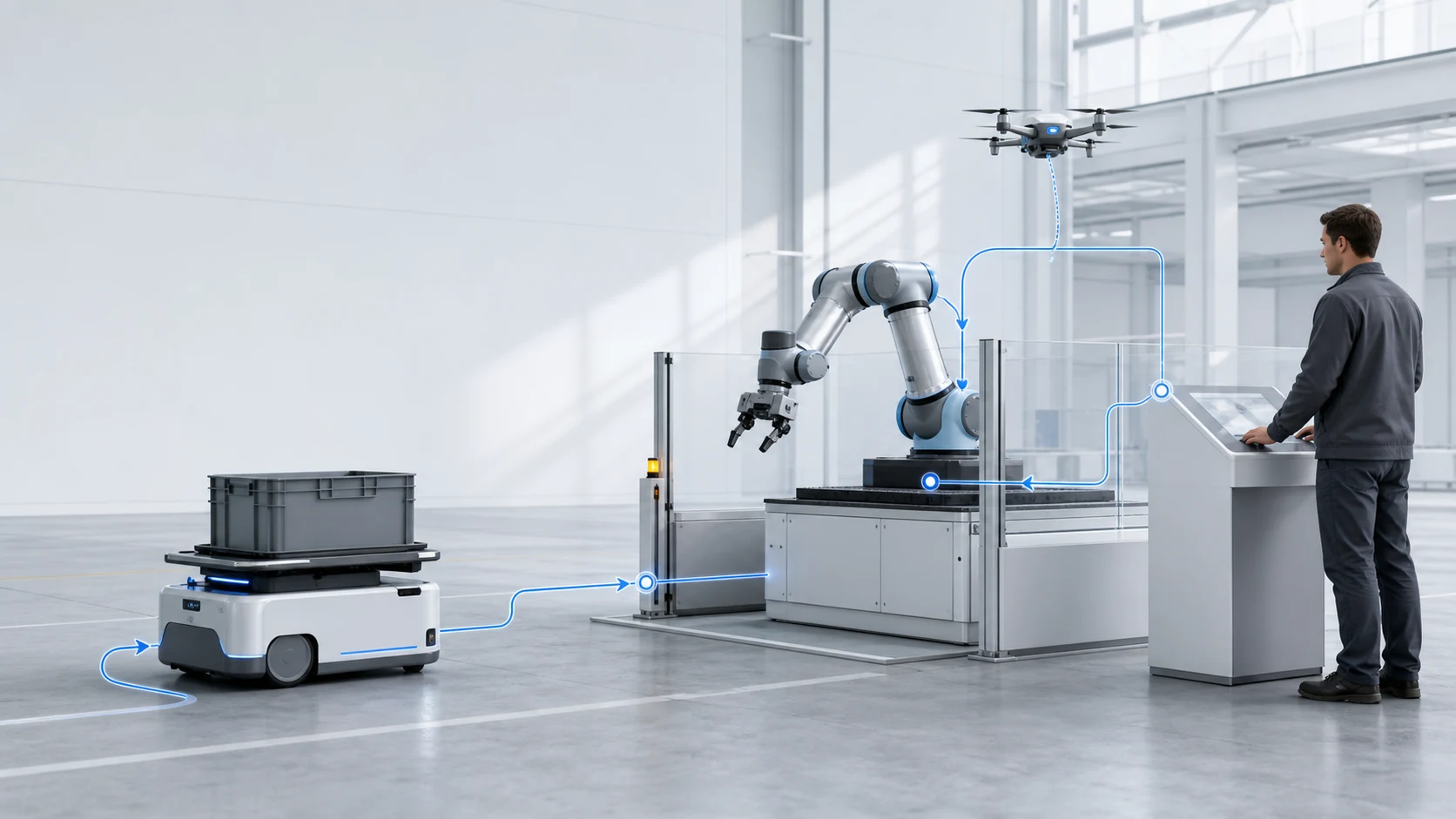
Consider a civil inspection workflow. A camera records a possible fault, a model helps interpret it, an operator reviews a service task and a transport robot is assigned. A model benchmark measures only one part of that chain. It does not reveal whether the original image waited in a buffer, whether the network delayed the result or whether the workcell was still available when the command reached the device.
Define the start and finish of the timing question before collecting numbers. Observation-to-recommendation, approval-to-device-receipt and receipt-to-verified-outcome answer different questions. Human review may belong in the operational record while being reported separately from the machine-processing interval. Combining them into one average can conceal the cause of a delay.
Instrument the waits as carefully as the computation.
Keep the capture timestamp, transfer boundaries, enqueue and dequeue events, inference start and finish, postprocessing, approval and command admission under a common run identity. Name the clock used at each boundary. Subtracting timestamps from different hosts requires a defensible account of clock offset and uncertainty; a local monotonic duration and a cross-host event order are different kinds of evidence.
Then repeat the same event path under representative contention. A short inference call behind a long queue may miss the task's freshness window. A camera buffer can deliver old frames over a healthy connection. Record variation and missed budgets alongside typical timings, and retain the failed or incomplete runs instead of averaging them away.
- Separate network transit, queue waiting and processing time wherever the instrumentation permits.
- Record model, preprocessing, runtime, hardware, workload and release identity together.
- Report the age of the observation at decision use, not just the duration of inference.
- Keep timeout, missing event and clock uncertainty visible in the timing record.
Compare edge placement with a controlled alternative.
ETSI's Multi-access Edge Computing work provides architectural context for moving application compute toward the network edge. It does not establish the timing of a particular robot workflow. Our engineering question is which placement preserves useful output within the agreed operating envelope.
Compare a local and a remote path with the same input set and task-level quality criteria. State any model or precision change explicitly. Hold the fault sequence and offered load constant, then examine queue growth, power and thermal pressure, data movement, availability and the behaviour when the remote service cannot be reached. Moving compute may remove one transfer while creating a new resource bottleneck.
A fast result still needs a valid handoff.
If a recommendation arrives after its supporting observation becomes stale, the system needs a task-specific treatment: reacquire the observation, narrow the recommendation or hold for review. If the observation remains current but approval has expired, new sensor data does not renew that approval. Timing, evidence quality and command authority therefore need separate fields in the review record.
Immediate motion, flight and emergency protection remain with the device's independent local control and safety functions. An advisory mission workflow should not imply that a model service has acquired a deterministic control guarantee simply because its typical response is short.
What the NODERIQ evaluation produces.
NODERIQ supplies the mission context for capabilities, constraints and recommendations. The NowFlow workflow layer connects human review, and the NeuraOS edge foundation connects approved intent with command admission and typed outcomes. A scoped timing engagement can produce a dependency map, instrumented baseline, local-versus-remote comparison and an acceptance record with unresolved limits.
The proposed NODERIQ-RCN investigation begins with reproducible host/QEMU conditions. That can examine software sequencing and recovery records. Physical latency, native transports, sensor behaviour and safe operating limits still require measurements and acceptance on the exact target. This article describes an evaluation method and reports no achieved reduction, field result or real-time service commitment.
Practical takeaways
01
Choose a decision boundary before choosing a latency metric.
02
Capture waiting, data age and clock uncertainty alongside model runtime.
03
Compare processing placements against the same workload and quality criteria.
04
Keep command authority and independent local safety outside an inference speed claim.
RA · Reference annexDefinitions, recurring questions, editorial method, and primary sources.Inspect
The analysis above carries the main reading flow. This reference layer keeps terminology, recurring questions, editorial method, and primary sources available without interrupting the argument.
Field questions
Program questions behind Robotic AI latency from sensor to action.
Q01Does moving inference to the edge guarantee lower latency?
No. It changes transfer, queue, compute and resource conditions. Measure the complete path on the intended target, preserve task-level quality criteria and examine degraded conditions before claiming an improvement.
Editorial record
How Robotic AI latency from sensor to action was checked.
- Editorial owner
- Neura Parse Research
- Last verified
- October 15, 2026
- Method
- Synthesis of the dated primary and official records listed below, checked against the operating question in this note.
- Scope limit
- Planning analysis—not certification, customer performance evidence, procurement advice, or a claim of production readiness.
SRSources reviewed
1 records