

Abstract
Error mitigation can reduce selected biases in selected observables under stated assumptions. It cannot certify that an unknown answer is correct, erase hardware noise, or replace fault-tolerant quantum error correction.
Gap map
Mitigation is an experiment inside the experiment.
The team first fixes the observable and acceptance rule, then compares a raw reference with one or more bounded mitigation configurations.
Pre-register
- Circuit and observable
- Expected range or baseline
- Precision target
- Acceptance and stop rule
Reference
- Mapped source snapshot
- Raw hardware estimate
- Shots and uncertainty
- Calibration context
Mitigate
- Suppression settings
- Measurement mitigation
- ZNE / PEA or PEC
- Noise-learning state
Judge
- Bias and variance change
- Sampling and time overhead
- Stability checks
- Accept, revise, or stop
Error suppression, mitigation, and correction are different controls.
Error suppression changes execution to reduce exposure to selected noise; dynamical decoupling is one example. Pauli twirling instead restructures an arbitrary noise channel into a Pauli channel and can mitigate coherent-error buildup, while methods such as measurement mitigation, zero-noise extrapolation, and probabilistic error cancellation estimate or cancel selected effects through additional circuits, models, or extrapolation. Fault-tolerant error correction encodes logical information so errors can be detected and corrected during computation.
Calling every technique correction inflates the claim. A mitigated expectation value remains an estimator produced under a method, backend, calibration, sampling, and model boundary. It should be compared, not declared correct by configuration alone.
TD · Technical depth6 supporting chapters and the working checklist.Read deeper
Fix the observable and decision rule before choosing a technique.
Mitigation is meaningful only relative to a declared quantity: an expectation value, distribution feature, energy estimate, symmetry, or other observable. Define the circuit, mapping, parameter set, comparison baseline, requested precision, uncertainty treatment, and acceptable total overhead before running variants.
Where a classically tractable instance exists, use it as a calibration or validation reference without assuming the same behavior will hold at larger scale. Where the answer is not classically known, use internal consistency, symmetries, cross-method agreement, held-out circuits, and stability checks as evidence—not as proof.
Never discard the unmitigated result.
The raw hardware estimate is the reference needed to understand what the mitigation changed. Preserve its exact circuit snapshot, observable, backend, calibration time, shots, precision, result, variance or interval, and failure state.
Run related variants close enough in time to reduce avoidable drift where the provider's execution model permits it. IBM's execution-mode guidance, for example, describes batch as a useful way to schedule independent mitigation comparisons together. That is provider-specific context, not a universal scheduling rule.
Choose the smallest intervention that answers the question.
Measurement mitigation addresses readout effects; suppression methods can reduce selected coherent or idle-time effects; zero-noise extrapolation estimates a zero-noise limit from deliberately varied noise; probabilistic error cancellation uses a learned noise representation and can incur substantial sampling overhead. These techniques have different assumptions and output semantics.
A higher resilience or mitigation setting is not automatically better. It can increase shots, QPU consumption, runtime, variance, and sensitivity to a stale noise model. Document why each enabled method fits the circuit and observable.
- Name the method and implementation version.
- Record noise-learning and amplification configuration.
- Keep extrapolator, factors, seeds, shots, and precision visible.
- Set overhead and failure limits before execution.
Treat overhead as part of the scientific result.
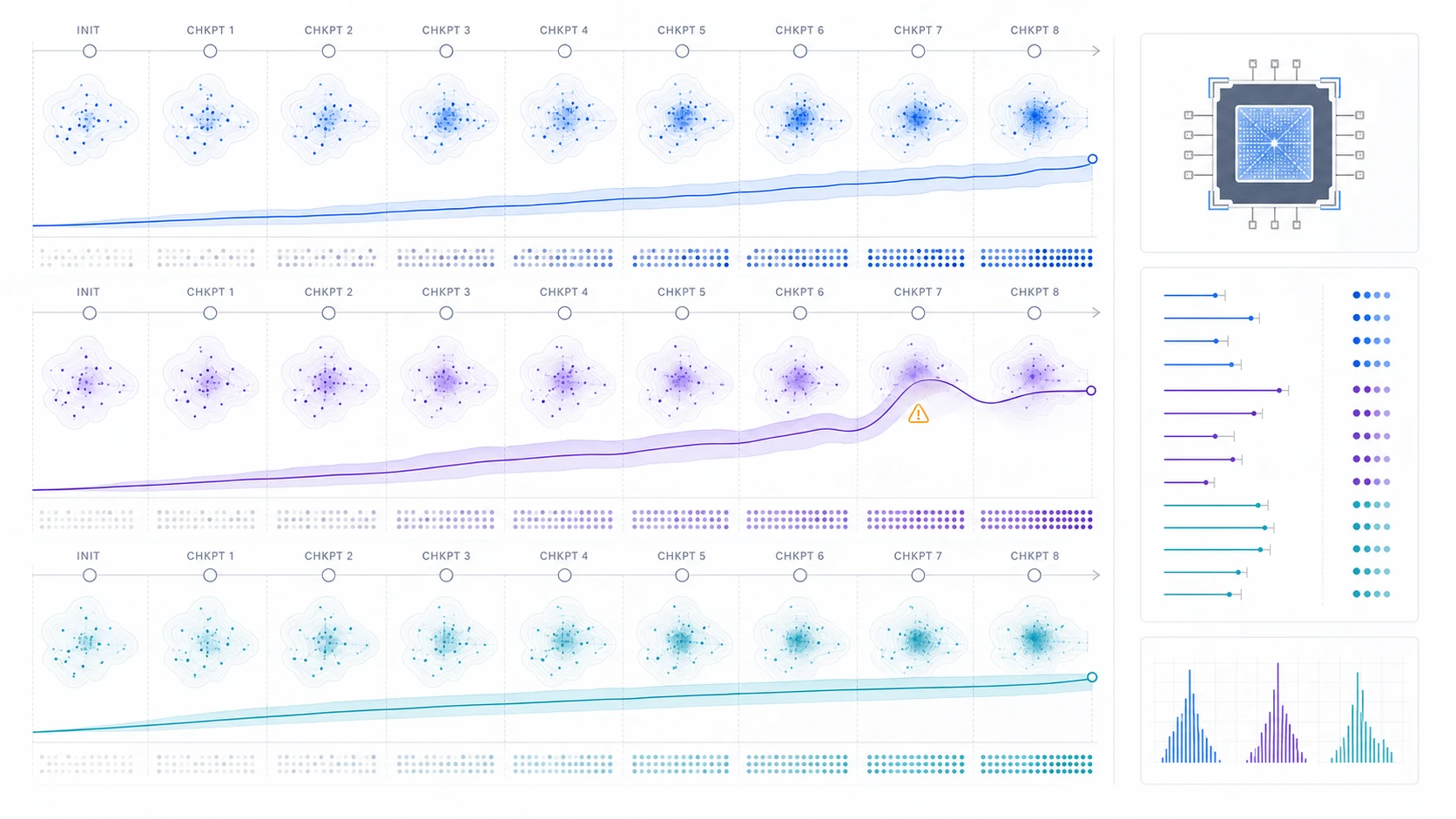
Mitigation may trade bias for variance or require many more circuit executions. PEC sampling overhead can grow rapidly with circuit noise, while ZNE requires multiple noise-scaled evaluations and an extrapolation model. The workflow must report total shots, circuit variants, QPU consumption, elapsed time, failed jobs, and the final uncertainty treatment.
If mitigation improves a point estimate but makes uncertainty or cost unacceptable, the experiment may not have passed. The decision rule should evaluate result quality and total evidence cost together.
accept only if improvement, uncertainty, stability, sampling overhead, and elapsed time all satisfy the pre-registered ruleLook for stability, not only movement toward an expected answer.
A result moving toward a desired value can be reassuring and still be misleading. Compare multiple settings, inspect monotonicity or fit quality where applicable, repeat across relevant calibration windows, and test whether conclusions survive reasonable changes in extrapolator, noise factors, mapping, or shot allocation.
Record negative evidence: failed extrapolation, excessive overhead, method disagreement, unstable fit, or a mitigated result that changes the decision unpredictably. These outcomes prevent a polished final plot from hiding the method's operating boundary.
Keep raw, transformed, and reviewed layers connected.
A QFlow mitigation packet should link the workflow and source snapshot, provider route, mapped circuit, raw run, each mitigation variant, settings, calibration and noise-learning context, shots, results, uncertainty, overhead, fit diagnostics, failures, reviewer note, and final decision. Provider credentials and private billing state remain excluded.
The final claim should be narrow: which observable changed, under which method and conditions, with what uncertainty and overhead, and whether that change crossed the pre-registered acceptance threshold. It should never imply general hardware accuracy or fault tolerance.
Practical takeaways
01
Separate suppression, mitigation, and fault-tolerant correction in both configuration and claims.
02
Pre-register the observable, baseline, precision, overhead ceiling, and acceptance rule.
03
Retain the raw result beside every mitigated variant.
04
Report sampling, time, fit, model, and uncertainty costs as part of the outcome.
05
Describe mitigation as bounded evidence, never as an automatic accuracy guarantee.
RA · Reference annexDefinitions, recurring questions, editorial method, and primary sources.Inspect
The analysis above carries the main reading flow. This reference layer keeps terminology, recurring questions, editorial method, and primary sources available without interrupting the argument.
Field questions
Program questions behind Quantum error mitigation: baselines, overhead and uncertainty..
Q01Does quantum error mitigation guarantee the correct answer?
No. Mitigation can reduce selected biases or estimate selected observables under explicit assumptions, but it can also add variance, sampling overhead, model risk, and fit sensitivity. Preserve raw and mitigated results and judge them against a pre-registered rule.
Q02Is error mitigation the same as quantum error correction?
No. Mitigation estimates or reduces error effects without providing a fault-tolerant logical computation. Error correction encodes logical information and detects or corrects faults during computation, with substantial physical-resource requirements.
Q03Should a workflow enable every available mitigation method?
No. Use the smallest technique set justified by the circuit, observable, backend, precision target, and overhead budget. More settings can increase runtime and uncertainty and may rely on noise information that becomes stale.
Q04What belongs in a quantum mitigation evidence packet?
Include source and mapped-circuit snapshots, route and calibration context, the raw run, every mitigation configuration, shots, uncertainty, overhead, diagnostics, failures, review notes, and the bounded acceptance decision.
Editorial record
How Quantum error mitigation: baselines, overhead and uncertainty. was checked.
- Editorial owner
- Neura Parse Research
- Last verified
- July 20, 2026
- Method
- Synthesis of the dated primary and official records listed below, checked against the operating question in this note.
- Scope limit
- Planning analysis—not certification, customer performance evidence, procurement advice, or a claim of production readiness.
SRSources reviewed
6 records