


Quantum computing comes with unfamiliar words: qubits, superposition, interference. It is reasonable to wonder where to begin. A useful first step can be much smaller than mastering the vocabulary: try a move, notice what changes and find one question you want to answer.
Start with a move that makes you curious
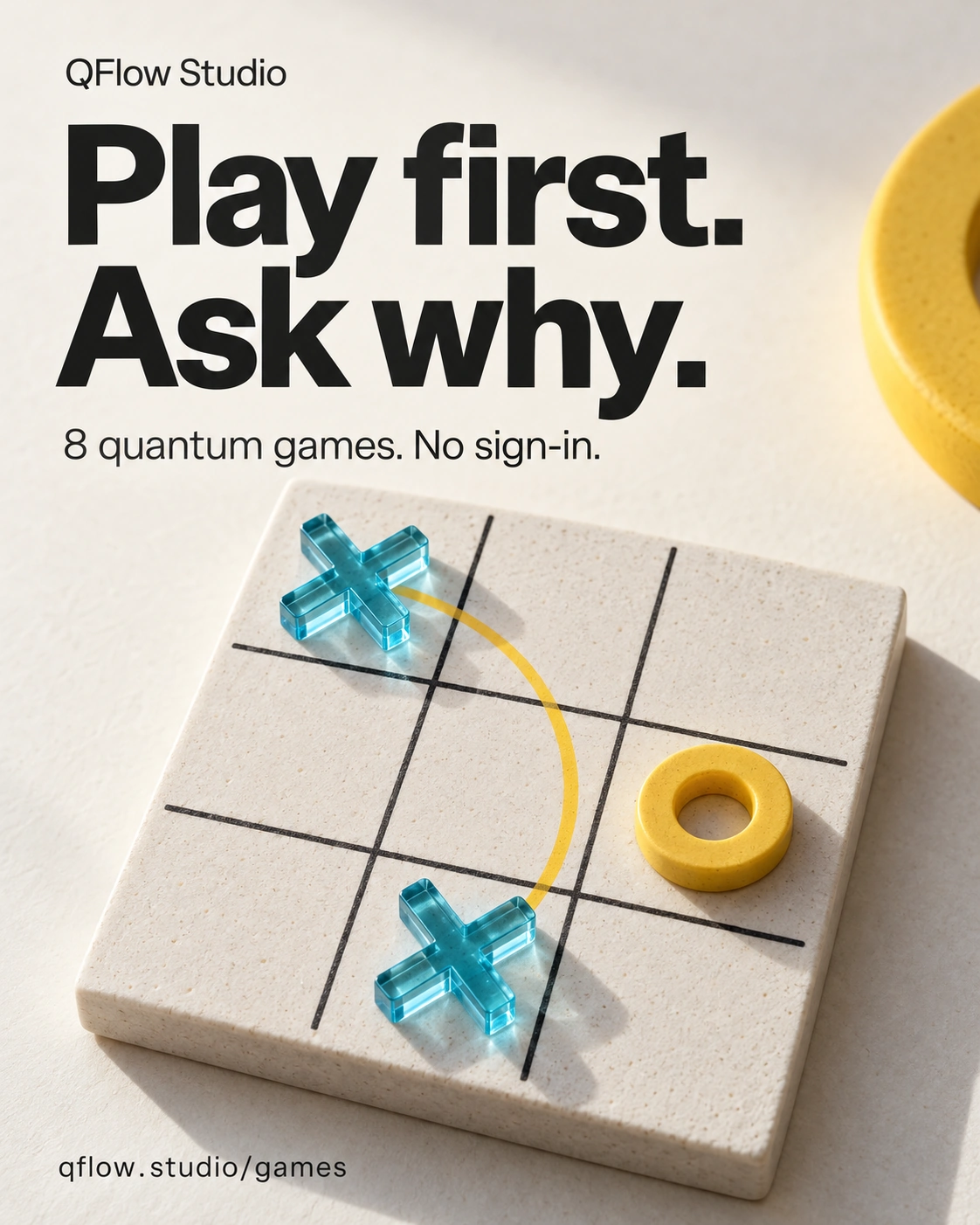
A familiar game can make an unfamiliar idea feel worth investigating. In ordinary tic-tac-toe, a mark goes in one square. In QFlow’s Quantum Tic-Tac-Toe, a move involves two squares. The interesting moment comes when you ask how the board will resolve them.
You do not need to explain the whole idea immediately. Play a few turns, read the rules and notice the point where your expectation changes. That gives you a concrete question to take into the explanation of superposition or measurement.
If a board game is not your thing, try Qubit Dial to explore how gates change a qubit’s state, or Photon Maze to investigate interference. The arcade has eight short games. They run local simulations in your browser, without sign-in, scores or saved progress. They are an introduction to the ideas, rather than a run on quantum hardware.
A little help from Astra
Sometimes the next useful step is simply asking a question in your own words. What is this gate doing? Why did that change affect the result? Which part should I look at first?
Astra AI is QFlow Studio’s assistant for exploring those questions and reviewing possible changes. In a Studio workspace, you can ask for an explanation or inspect an edit proposal before choosing what to apply. Starting a run remains a separate action. AI availability follows your account and workspace settings.
Try a question with a clear point of comparison: “What changes if I remove this CX gate?” Or ask for a different explanation: “Walk me through this circuit without assuming I know the notation.” The aim is to leave with a question you understand more clearly, rather than a paragraph you feel you have to accept.
Take one idea into a circuit
A game gives you something to notice. A circuit gives you a way to inspect the operations behind a small experiment. QFlow’s public Bell example is a useful place to make that transition.
Look at the H and CX gates. Compare the ideal readout with and without CX, and make a prediction before trying the change. When the outcome differs from your prediction, return to the explanation and ask which assumption you made. You can explore this public example without connecting quantum hardware.
As you become more comfortable, follow the circuit into its code view. You do not have to understand every line at once. Start by finding the operation you changed and the measurement that reads the state.
Leave yourself a useful note
After a short experiment, write three simple sentences: what you expected, what you changed and what you noticed. If you still have a question, keep that too. It will be a better starting point next time than trying to remember which button you pressed.
A game, an assistant and a circuit offer different ways into the same subject. They do not remove the need for mathematics or careful reasoning as you go deeper. They give you something concrete to reason about.
Choose a small place to begin
You can start with a game, a public circuit or a question for Astra in your workspace. Choose the one that feels approachable today. Try one thing, look closely and let the next question come from what you actually see.